Six Mad South African Stories

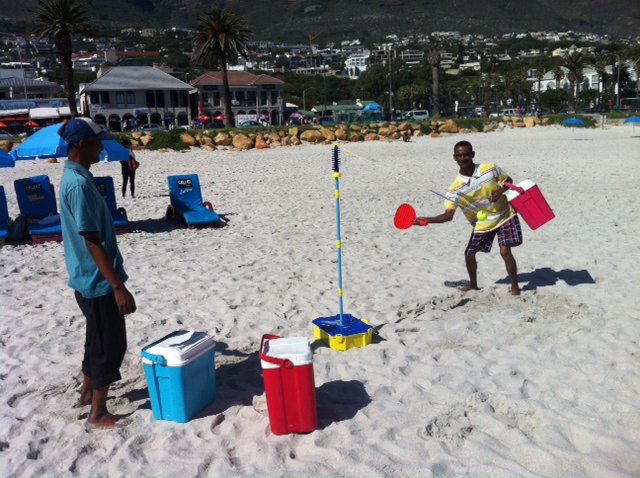
Yesterday on Camps Bay beach two guys selling cold drinks decided to have a go on our swing ball set. I wish I could have recorded their giggling and the things they were saying to one another (Djy speel kak! Slaan hom! Slaan hon!). One of those lost-in-translation moments.
Yesterday on Camps Bay beach two guys selling cold drinks decided to have a go on our swing ball set. I wish I could have recorded their giggling and the things they were saying to one another (Djy speel kak! Slaan hom! Slaan hom!). One of those quintessentially South African, impossible-to-translate moments.

With this trial going on and on and the awful Nkandla scandal and that book that’s just come out about the crisis our education system is in it’s easy to get a bit despondent and start thinking, fokkit, Hermanus, what’s to become of us, and when that happens it’s good to be reminded that, while we live in a country where the future is every part of uncertain, the flipside of this is that hardly a day goes by without something mad/funny/ridiculous happening that makes you laugh out loud or shake your head in dismay or be warmed to the bone with the kindness and resilience of human beings. And, after all, we are not here to experience perfection; we came to experience love and humanness in all of its manifestations. Here are some true stories gathered over the past twelve months.

The Blind Beggar and the Lotto Tickets

My mom told me this story over chicken curry a few nights back. She was standing in the queue at Shoprite to buy her weekly lotto ticket (‘if you don’t buy, you can’t win’, as my dad always says), and ahead of her was a well-dressed, blind beggar – really smart in a suit and hat, being led around by a young woman who helped him empty the contents of a plastic packet onto the counter. The cashier looked horrified and like she was about to protest but changed her mind and proceeded to count out R72 entirely in brown coins. There was not a single piece of silver in the mix. With the entire R72 the two of them bought lotto tickets. That’s called faith. Or something. I hope they got at least a few numbers right.

The Naked Rastafarian in the Garden

We don’t have a fence around our property, and a while back my kids called me and told me there was somebody in the garden. I went out to have a look, and there, washing himself at the outside tap, was a young Rastafarian homeless guy in his late twenties or so. He had Tresemme shampoo and a loofah. I went over to where he was squatting and said, listen, dude, I don’t mind if you need to wash, but don’t let the tap run for so long, you make everything waterlogged. He stood up and faced me, naked as the day he was born, and nodded that he understood, but the next day he was back, and then he was coming twice a day and it started to get on my nerves. My polite requests that he didn’t come quite so often fell on deaf ears, and eventually, after a couple of weeks, I told him not to come anymore, but there he was, twice a day, and I live alone half the time and the whole situation started to get a bit problematic so we took matters into our own hands and replaced the tap with one that has a removable top. You can’t turn it unless you have the top bit, and we put the top bit inside. The next time he came he stood staring at the tap in bewilderment. Then he climbed up the steps to our deck where there is a working tap, but where all of Green Point would be able to see him washing his bum, so he just stood there for a while not really knowing what to do. I felt a bit bad and went outside and said, sorry, man, but really, it was getting uncool. He shrugged and went off on his way and I haven’t seen him since. Shame. He just wanted to be clean.

The Lady at Fruit and Veg City

All this cancer everywhere really freaks me out, so I’m trying to feed us all healthy food, and the kids and I have a little game where we each have to make sure we get 7 servings of veggies and fruit a day, and it’s quite fun, actually, seeing how many greens you can squeeze into a sauce or a soup. Or, before supper, I give them a ‘starter’ now which is cut up apple and blueberries and cherry tomatoes and carrot sticks and the kids think it’s great, and I feel like a less crap parent. Anyhow, Fruit and Veg have nice stuff lately – fancy mushrooms and tiny baby carrots and fresh, interesting salads so I try and go there more, and as the cashier was ringing up my stuff and I was looking over her shoulder thinking of something or other, she suddenly stopped dead, looked me in the eye and said, ‘where are my manners? Hello. How are you, and did you have a nice weekend?’ I was surprised, but also not, because you do get that kind of thing happening down here. I told her I missed my husband but that I have good friends who kept me busy. She patted me kindly on the arm and said, ‘it won’t be long now.’ And I walked out of a budget supermarket feeling like the world is a kind and gentle place.

The Day my Mom Got Mugged

Arriving home at about 6pm one winter’s evening, suddenly a young man with a knife appeared at my 68-year-old mom’s side and demanded she give him her bag. She said, ‘I’m not giving you my bag. There is nothing in it of value, but it is of value to me.’ He started to argue so she ordered him to sit down where she proceeded to show him her near-empty wallet, her old, worthless cell-phone and the punnet of mushrooms she’d just bought at the Spar. She said, ‘I’ll give you R100 but you are not getting anything else.’ He agreed and went on his way. When she told me the story a few days later I didn’t know whether to be proud or horrified. I still don’t know.

The Honest Granadilla Lolly Guy

Those guys on the beach are so freaking annoying with their cooler-boxes of ice lollies (a lolly to make you jolly?) when you’re trying to read your Heat magazine in peace, but a few months ago I took the kids to the beach and, just as we’d settled, I spotted a friend 50 metres away. Too lazy to go all the way over there, I phoned her and told her to join us, which she duly did. About ten minutes later, one of the ice lolly guys approached us again, this time with a fancy new Samsung smart phone in his hand, and asked us if it belonged to one of us. In the process of gathering her things, my friend had dropped her R8000 phone in the sand, he had spotted it and was doing the rounds. She gave him R50. He probably lives in a cardboard box.

The Jolly Christmas Bergie

On High Level Road about around Christmas time I was on my way to work and a bit stressed and grumpy because when you have young kids trying to get everyone fed and dressed and out of the house on time requires great reserves of patience which is not my strong point, and as the traffic slowed down there, just to my right, was a bergie going through a bin, and while there is nothing unusual about this, what was unusual was that he was wearing one of those red, felt pointed hats with the flashing lights and he had the lights going full tilt while he sang ‘We Wish You a Merry Christmas’ at the top of his lungs. While you might be sifting through the trash for your next meal and Christmas will probably be a bottle of something cheap and lethal, aint no reason to be a misery guts. Big lesson to us all.

There are some sick, weird f?cks out there – and 4 other things blogging has taught me

Today as I looked at my site stats I noticed, by chance, that to date I have written 99 blogs which means that this one you are reading marks 100. And, while I was going to write about something else entirely, it feels like I should commemorate this round number in some way. And I think the best way would be to reflect on what those 99 blogs were like to write, and what they’ve taught me about people and about myself. So, here goes:

1. They are some sick, weird fucks out there parading as normal people

Sometimes I find myself in the queue at Checkers looking at somebody who appears to have it together and is just out buying rolls and wondering if it was them who wrote me that spewy, venom-filled missive about how much they hate me and my blog and that I should go away and die forever and also that I come from hell. There are some people walking among us who seriously need a hug and a therapist, in that order, because they are so sad and angry that they hardly know how to contain it. And illogical. And harbouring more bitterness than an aloe on the Swartberg Pass. And I try to remember that it’s nothing to do with me and all about them, but sometimes I can’t help being shocked that human beings can have gotten so damaged along the way. I mean, were they kept in a cardboard box and fed ants when they were children? And I think about how bad their lives must be, and I try to understand what drove them to this point, but honestly, I can’t. And then I decide to feel sorry for them and the people who have to live with them and move on.

2. …but many more awesome ones, so who even cares about the freaks?

Over and above the vast majority of people who like the blog and write nice things and tell me their own stories, a handful have contacted me personally and I can honestly say, over the past year or so, that they have become friends. Not just ‘friends’, but friends – people I would (and will) meet with next time we’re in the same city (I’m talking primarily to you, Mark, Tanya, Johan, Jennie). Good people, kindred spirits with warm hearts and happy energy. Who knew that would happen?

3. You’ll only ever please 80% of your audience

I can write the sweetest, most heartfelt and uncontroversial piece in existence and I’ll always have that one person who cannot resist being a schmuck and posting a snarky comment. At first it surprised me and made me question myself and what I was doing. Now I expect it and am even a little disappointed when I don’t get to spam at least one person a week. So come on, Trolls, don’t let me down!

4. Only ever write from the heart because people know the difference

Sometimes I’ll write something, the honesty and revelatory nature of which makes me shudder at my own out-thereness, and I press the ‘publish’ button with trepidation and worriedly wait for feedback, and then the reactions I’ll get will be so heartfelt and sharey as people seem grateful to have their own lives/feelings affirmed and that I’ve made it okay to speak the truth about situations they know all too well. Your audience has a sixth sense for BS, so don’t insult people. Having integrity as a writer means telling it like it is even when that notion is scary.

5. We are (much) more the same than different
Underneath it all – the cost of our handbag, the texture of our hair, the kind of school our parents could afford to send us to – we are like one person with minor, pretty irrelevant details. That’s my experience, anyway. I have 70-year-old white men and 18-year-old black girls reading and relating to my blog. Which is pretty surprising, but true. We all want the same things: to be happy, to be loved, to sometimes make sense of this life we find ourselves navigating without a compass. And if we could remember that more it would help us to be kinder and more forgiving of one another, and of ourselves.

Thank you for the amazing lessons you, my readers, have taught me xxxx

Gaaning Aan About isiXhosa Again

A few weeks ago I went to the Baxter theatre to see a play someone who reads my blog urged me to go and see called Death of a Colonialist. It’s about a white history teacher in Grahamstown who gets a little obsessed with the Xhosas and the frontier wars and whose teaching methods, as a result, get more and more unconventional until he’s removing his shirt and covering his face and torso with red ochre like the warriors used to do before going into battle and – to the bemusement of his pupils – emulating battle scenes in the classroom. And the play is multilayered and has many themes – white voices and their relevance in the present day, the role power plays in our recordings of ‘history’, the deep love for a country which isn’t, by rights, ours and the emigration of young South Africa people. And it’s a very apt piece of theatre as it addresses so many issues we’re dealing with right now, and I related to many of the demons the protagonist was battling.

As we entered the auditorium this music was playing, Xhosa songs sung by men with deep voices, a magical sound resonant of the earth and the red sand and green fields and rivers and the overarching African sky. It was a sound less like people and more like ancient and forever, and again I started to think of this language issue because – like we saw in the case of Afrikaans and how this new, malleable language was modified and used as a weapon of power and oppression – the words we speak and the way we speak them are what ultimately constructs our reality and defines our world. And what I don’t get is why, in 2014, 20 years of democracy later, my daughter in Grade Four is instructed in Afrikaans three times a week and in isiXhosa, one. And I love that she’s learning Afrikaans, but one isiXhosa lesson a week is just not going to cut it. She’s not going to master this language beyond the sad, inadequate molos and usaphilas I was taught at my apartheid regime school back in the year dot.

And I don’t understand this decision by the Education Department because – if you’re going to call South Africa your home – isn’t that language actually the most important one to know? Because can we ever really attain equality with people when they are consistently having to compromise and speak to us in broken, accented English while ours is all proper and hootah hooh when the least we could do is meet them half way and speak crappy isiXhosa back? Implicit in these interactions we conduct in our mother tongue while the people we’re speaking to have to struggle and use bad grammar are assumptions and something very much like arrogance. And if we were all – and I include myself totally – were that committed to change in this country, to integration, to real egalitarianism, wouldn’t learning Xhosa be the very least we could do?

Because language isn’t just about words – it’s about concepts and ideas and ways of interpreting the world. In many ways it holds the key to who people are inside. Language unlocks belief systems and unveils truths about how reality is perceived. As those of us who speak Afrikaans know, it’s impossible translating this language into English, especially in its orginal Kaaps form. It just won’t bend the right way. While you could spit on Denmark from Sweden, the different way Danish and Swedish have developed tells you a lot about the people you’re dealing with. In Denmark, for example, the fact that there is no word for ‘please’ is an important clue that these folk are direct, no-nonsense types who like to call a spade a spade.

When you speak to a Swede, by contrast, not only will they say please (‘snälla’) and thank you very much (tack så mycket) a lot, their sentences are peppered with the word ‘käns’ (pronounced shence) which means ‘feel’. Being generally more sensitive than their cousins across the ocean, for Swedes feelings are paramount, and you’ll hear a lot of ‘I feel…’ or ‘how did that feel?’ in conversation, whereas in Danish the equivalent word doesn’t exist. In that language, instead of a ‘käns’ there are words for ‘I think’ and words for ‘I believe’ – which tells you they’re less interested in the emotional aspect of things.

And – like most of us lazy, swak white South Africans – I don’t know isiXhosa so I can’t use examples from that language, but by the way many Xhosa people speak English and Afrikaans you can hear there are vast differences and from that infer that a lot is getting lost in translation. And while I love the sound of this language and have a read a little bit about how complex and nuanced it is, and sometimes when I drive I practice the different clicks to myself and think it’s big fun to say, ‘hayi suga wena’ and ‘jonga!’, I don’t google Xhosa lessons in Cape Town and go and sign up and learn how to speak it like I should. And I don’t know why I don’t. Laziness and intertia, I suppose. But I think it really would make a difference.

I couldn’t find the exact song on YouTube (it’s called ‘Nontokasi’), but this has a similar sound.

http://youtu.be/nIDNXChbTkM

How the Contraceptive Pill Made Me Crazier Than a Rabid Iguana

Me, just crazier.
Me, just crazier.

I guess I should have seen it as a warning from the universe when I told one of my best girlfriends that I was going back on the contraceptive pill and she said, wow, that pill makes me insaaaane. And this from a gentle, chilled out little Piscean who is about as not insane as they come. But instead of thinking, ja, insane could be a problem, I confidently assured her – as I myself had been assured – that this new generation of birth control pills is totally different from its predecessors of 20 years ago, and even if the ones from the olden days disagreed with you for whatever reason, these new low-dose numbers were a veritable stroll in the park, hormonally speaking.

So, as I swallowed that first small, pink tablet and sat on the couch waiting to have a thrombosis (the side effect they do remember to warn you about), the idea of going bat crazy was the last thing on my mind. Since they said it took seven days to be effective, I waited, and while waiting I monitored myself and how I was feeling – just in case – and up to day six, everything was pretty hunky dory. But then came day seven. This was also my daughter’s seventh birthday and, since I’m not good on not-enough sleep and as we were having friends arrive to stay that same day and it was going to be busy and hectic I asked her, the night before, to pleeeease try to wait till 6am before she woke us up.

But, she is seven and her birthday is the biggest event of her year, and 6am is a long time to wait when you’re that young, so it was still dark when her and her sister snuck into our rooms and announced that the gift opening was about to begin. Normally I would be a little grumpy but pull myself together, make a strong pot of coffee and get immersed in the excitement of her big day. Instead, I was a thundercloud. Rage doesn’t even describe the blackness of my mood. My family watched in surprise and bewilderment as I thumped about, furiously blowing up balloons, angrily icing the cake, going on a tidying rampage and then crapping on my husband for something he did six weeks ago. And still (duh) I didn’t put two and two together.

It took all the way till the following day, as I sat sobbing in the front seat of the car on the way to my favorite beach in the world on a perfect-weather Sunday morning where we were going to boogie board, play bat and ball and have coffee with Cremora and slap chips for breakfast (I mean, does life get any better?) for me to go, okay, hang on a dang moment – what the fuck is going on here? And then the penny started to drop as I realised I recognized this feeling – this odd, prickly and difficult-to-describe kind of malaise where you feel like you don’t belong in your skin and even though nothing different is going on you are madly on edge as, at a speed that stuns even you, wild anger gives way to tears and sorrow and sadness.

Because this is how I felt for most of my twenties on a triphasic pill which had me, towards the end of the month, wanting to rip my own hair out in chunks. And nobody presented emotional disturbances as even the vaguest possible side effect, so how was I to know it wasn’t just my personality? And I can be mad, don’t get me wrong, but my mad and I go back a long way and we are very well-acquainted. I know what it’s about and what triggers it (thank you, clever therapists), and for the most part – give or take the odd irrational moment (which generally happens when I’m tired and hungry) it doesn’t make itself known very often anymore. And my madness definitely doesn’t involve indiscriminate rage and absolutely definitely never ever does it involve depression. I get sad like everyone else, but my sadness is about something. For the most part I’m cheerful and resilient and upbeat.

That person crying in the car on Sunday morning? That was not me at all. And it’s just kind of weird that no-one warns you about this side effect. In fact, I was assured it was all psychological (a friend’s gynae told her her lack of libido since taking the pill was psychological, too. No, it isn’t, stjoepid!) The second I got home from the beach I went online, and I was astonished at the amount of information and stories shared by women who had exactly the same thing happen to them – going from (relatively) normal and together to stark raving lunatics, and the longer they took the pill, the worse their symptoms became. And they all describe it in the same way: they feel like they’re ‘going crazy.’ Then I read about how women on the birth control pill show activity in different areas of their brains to women not on the pill and how, in fact, studies indicate that they make different choices in partners than their non-pill-taking counterparts, foregoing thrill-seeking, adventurous men for quieter, more stable types.

Which tells you that it is, in fact, having an effect on us, and given the complex nature of the endocrine system and how much the pill changes the way women’s bodies work the surprising thing would be if it didn’t do anything weird. And I’m not saying it has this effect on all women or that you should stop taking it if it’s working for you. I have several friends who take the pill very happily and love it. But I also have a handful who won’t touch it with a barge pole for the same reasons as me. I stopped right away, and today is the first day I’m really feeling 100% myself. And I think this potential symptom should be presented as a real possibility and not swept under the rug by medical people who don’t believe it/think it’s exaggerated/haven’t encountered it personally because this type of meltdown, when you’re not prepared for it, is actually really pretty scary and horrible. And life for us chicks is weird enough as it is.

So, if nothing out of the ordinary is going on in your life, but your recent switch to the pill has people removing their children to a safe place when they see you coming you might want to consider that it’s not working that well for you. We’re all different, and some of us are more sensitive to hormonal changes than others. That’s just the way it is. You know your body – listen to it. If it’s not good, stop and find another way. The convenience just isn’t worth it.

Dance – you’re Afrikaans!

Johannes Jacobus Botha as a young man of 26.
My grandpa, Jan Jacobus Botha, as a young man of 26.

I think the two most surprising things I experienced travelling and living ‘overseas’ was that everything was not, in fact, cooler/better/more fabulous than it was in SA (we Saffers suffer from a terrible inferiority complex in that regard), but also how deeply, madly and uncompromisingly South African I became. Before I left the country I had a tenuous, undefined and vaguely apologetic sense of my own heritage. But – and I guess this is identity politics 101 – put me amongst a clan of white-blonde, herring-marinating, super-stylish Scandinavians, and I was one step away from wearing a lion skin to the Vårdcentral and throwing bones for people as my party trick. Since I didn’t own a lion skin, what I did instead was join a South African book group and learn to bake rusks and source a boerewors maker in Copenhagen and phone my mom just to weep when I heard Alicia say, ‘molo, Sisi! Kunjani?’

And the other thing I did, after not doing this thing for many years, was start to speak Afrikaans. Afrikaans – the language of my country, of my childhood, of my history with its uncompromising ‘r’s and it’s guttural ‘g’s that sound like they come from inside the earth, itself. Its verkleiningsvorm that adds ‘tjie’ to small things so that they shrink before your very ears, and its words which are so unique and descriptive that they refuse to be moulded into the clipped, uptight and inflexible rigours of English. Nothing is as crawly as a ‘gogga’; nothing says you’ve hurt yourself like ‘eina!’, and that’s not even touching on the assortment of swear words and abuses which are so colourful they verge on psychedelic.

And, of course, the more ‘Kaaps’ you get, the more evocative and descriptive Afrikaans becomes. And it’s a shame it got associated with all that bad stuff. That a language so vibrant and defiant and home-grown became branded and white-washed and sterilized so that it served the purposes of a few power-hungry old men who loved this country but not its people, and, in the way language constructs reality, was used as a very effective tool of oppression. Which, given its origins – a ‘secret’ language developed by slaves so that they wouldn’t be understood by their tyrannical masters, and also a rebellion against speaking the language of their oppressors – is deeply ironic. Another thing I only discovered recently is that ‘kombuis’ in Dutch signifies a ship’s galley. Which implies that it might not be ‘kitchen Dutch’ as we have always understood, but ‘ship galley Dutch’, which carries its own insidious connotations. And its hybrid of Dutch, Portuguese, Khoi and Malay (with some Xhosa and Zulu influence along the way) makes it magnificently unique and special as languages go.

And while I wasn’t nearly conscious enough at school to understand that Afrikaans was a tool of apartheid, the overt preference the Afrikaans kids got in my dual-medium Somerset West school was enough to distance me from it and all it represented. We English-speaking kids were largely regarded as wayward and traitorous and, despite being as South African as they come, in this country of divisions and apartness, our affiliations were somehow believed to be British. Because Afrikaans was not our home language, we were not ‘true’ South Africans, and I have vivid memories of teachers comparing us negatively to the Afrikaans kids, a censure which hurt me at the time, being a diligent, conscientious student who loved my school and was very proud of my good grades.

Because I suppose, even though we were children and clueless, the Anglo-Boer war with its concentration camps and brutal treatment of the Boers was still fresh in a lot of minds. So that when my maternal grandfather, Jan Jacobus Botha, who grew up poor on a farm in the Eastern Cape, went to school barefoot on horseback and spoke Afrikaans and Xhosa but not one word of English, met and fell in love with Emily Norah Elizabeth Dilley who spoke no Afrikaans, their families were none too pleased. And when, in a real Romeo and Juliet-style saga they married anyway, his family, who lived literally down the road from their home in East London, would sit on their stoep and refuse to greet my granny when she walked past.

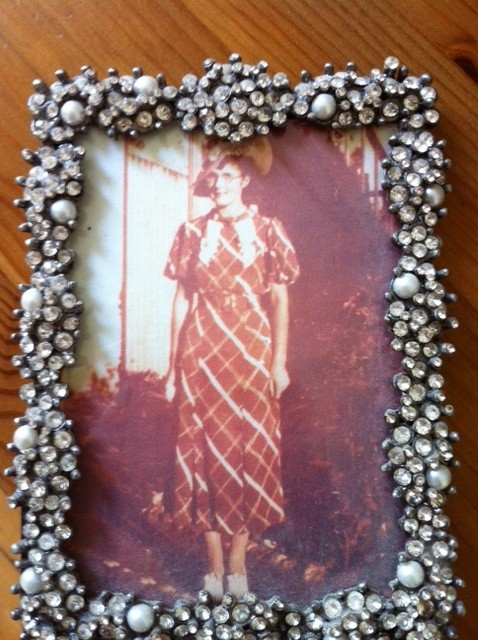
The beautiful Emily Norah Elizabeth Dilly.
My beloved granny, the beautiful Emily Norah Elizabeth Dilley, shortly before she married.

Unfortunately, in those days, Afrikaans was – and still is in some quarters – considered a lesser language, and my granny made it a condition of their marriage that their children would be raised English-speaking. So, while both my parents are bilingual, my accent is bad, and I wish the language hadn’t been allowed to slip away over the generations as it has. But, with growing up, I’ve learnt to love it again and appreciate it and consciously embrace it as an integral part of my heritage. In a strange way I feel like my Afrikaans roots bind me to the soil of this country, and legitimize my living here. Because the Afrikaners were, really, South Africa’s white tribe. I wish I’d been older when my grandpa was alive so that I could have asked him questions about his life back then. And I wish I’d been awake enough to tell him not to speak his accented English to me, but to talk to me in his mother tongue, using the words of his own childhood to paint pictures of the world.

Now I rely on my mother’s memory to keep my ancestors alive, while in my own mind I’ve reclaimed the culture for myself. For me, it has nothing to do with those cross men and their brylcreem who didn’t smile one time in their lives and conjured a political system madder than your wildest imaginings. It’s a connection to this corner of Africa; my soul’s dompas, if you will. The blood of those people who fought and suffered to live freely in this country runs through my veins, too. And to the ones who say I don’t belong here, I answer in my best, accented Afrikaans, ‘fok jou! Gaan vlieg in jou ouma se klein kwassie!’ And I defy anyone to translate that.

I think this is one of the most beautiful songs ever written. It’s by the late Koos du Plessis, and it was used in a TV series when I was growing up, but I don’t remember which one.

Carnivals and Gardens

The Oresund Bridge which takes me home to Malmö and home to Cape Town.
The Oresund Bridge which takes me home to Malmö and back home to Cape Town.

When you live in a country like South Africa, which has experienced – and continues to experience – change on a massive scale and where the disaster zones of many other African countries ruled by liberation governments hang over us like a panga ready to strike us into economic oblivion, conversations about where it’s good to live versus where it’s not so good to live become commonplace. And even more so for those of us who are thinking about leaving or thinking about coming home or have come home already or never want to see South Africa and Mrs Balls chutney again. And these debates go back and forth led by words like ‘lifestyle’ and ‘crime states’ and ‘education’ and ‘future’, and they are discussions which can go on endlessly without ever reaching conclusion because fundamentally they are personal and emotional, and more often than not our decisions are based on instinct and circumstance and what feels right for us versus what doesn’t.

But something I have been thinking about lately, and which is not often taken into account in these conversations – but which I believe to be true – is that different places/countries have a different energy (to be a bit shoo-wow and tie-dyed of a morning) which either resonates with ours or doesn’t. And we’ll insist on being practical and citing ‘facts’ as to why we live here versus there or there versus here but I think it boils down to something else. Like we pick partners and friends who ‘click’ with us, we choose the place we call home in much the same way. I have only lived in South Africa and Sweden, but since it would be hard to find two countries more diametrically opposed, I think they’re pretty good examples to use. I’m negative about Sweden sometimes because I was unhappy there, but I also love the country and larger Scandinavia in the way one does when a place has been your home. You can’t live somewhere for a long time and not have it become a part of you.

And I’m also more critical of it than is fair – out of defensiveness – because so many people are aghast that I left a place where everything is ‘perfect.’ And it is kind of perfect in a lot of important ways, but it wasn’t perfect for me. To employ a metaphor, Sweden is like a magnificently manicured garden full of beautiful flowers. There are water fountains, comfortable places to sit and good things to eat. People speak politely in muted tones and the air smells of freshly brewed coffee. You’ll never get lost because there are clearly demarcated paths, and the garden is ringed with stylishly decorated, very high walls that you’d never be able to scale. You are safe and you are secure. You are also walled in. For some people, the walls are a small price to pay for all that comfort. Why would you need to leave when everything is right there at your fingertips? It’s very nice there; very nice indeed.

South Africa is more like a huge, gaudy amusement park where nobody has checked the safely standards of the equipment in a long time. People climb on the rollercoaster and they feel the sun and the wind on their faces and it fills them with a delicious kind of joy, knowing that an any given moment the little car they’re strapped into could careen off the tracks and go sailing into the ether, taking them with it. But, damn that ride is fun. And it seems to go on forever. And everyone is smiling as they go around and around, and life is uncontained and open-ended and there are no barriers and the possibilities are endless. The amusement park smells of dust and oil and boerie rolls and beer, and clowns fall off barrels and people laugh and it’s colourful and in-your-face and totally unpredictable.

And I can understand why people choose the manicured garden. It’s a great garden, as gardens go. But the amusement park has a wildness which can be quite irresistible. Because you might fall off, but you also might not, and in the interim you are having such a damn good time. And objectively, it’s impossible to say which place is ‘better’. South Africa is awesome for some things, and other places are awesome for others. It’s just about what works for you, and where you feel comfortable and ‘right’. Once, about half a year before we moved back to South Africa, I was given a voucher for my birthday to visit an astrologer/healer. He was an African-American who must have been close to 80, and he’d been living in Sweden for most of his life. From his small, warm apartment in the suburbs he read to me my chart, and then out of the blue (not knowing I was leaving) he said something interesting and surprising. He said, ‘I have to tell you something – if you stay in Sweden you’re going to get sick.’ And I knew exactly what he meant. The country’s energy and I were not a good match.

Now when I go back on holiday I’ve learnt to wear one of those ‘balancing’ bracelets (whether they work or not is anyone’s guess) because, even though I’m really happy to be back and seeing good friends and swimming in the warm sea and enjoying the long days of summer, I experience odd physical symptoms – dizziness, disorientation and a vague sense of not getting enough air. I never feel this way in South Africa. And maybe it’s psychosomatic, but I think it’s something else. It’s the walls and the safety and the lack of spontaneity and madness. I’m just more a clowns and rollercoasters kind of person. And we’re all different like that. And sometimes I envy the garden folk their sense of belonging and wish I shared it because all that tinny carnival music can get noisy when you’re feeling tired, and you’re so busy dodging coloured balls there isn’t much time for reflection. But mostly I love the chaos and the freedom it affords. And that, if the mood takes you, you can fly right up to the sky.

A Moment

The first time I saw him he was standing on Jammie steps with his back to me, broad against the sunlight. He was dressed like Jim Morrisson in a white pirate shirt and a series of leather necklaces. He laughed, and shook out his hair – lustrous long, brown curls that fell well past his angular shoulders. He was rangy in the way only 22-year-old men can be, and it took me some time before I realised he was something of a legend on that campus. He hung out with a posse of impossibly beautiful black girls. Rich, skinny girls with flawless skin and expensive sneakers and straight, white teeth. I’d watch him with them – the easy way they touched him like he wasn’t Jesus, just some guy studying anthropology.

I found out his name was Ben, and that he was foreign and a member of the Mountain Club. And someone told me where he lived and after a while I got a vague sense of his routines so that I knew, more or less, when he’d come sauntering by in his faded jeans and 6 foot 2-ness. And then he’d be gone again, somewhere else, and I was not cool at all nor pretty enough to compensate for my lack of street cred and there was no reason in the world why a guy like him would ever even think of a girl like me. And I didn’t question the order of the world for a second. Even though it seemed like that same order was about to change in a big way. Because, all around us, things were starting to give. In the words of Chinua Achebe, the centre could no longer hold; things were beginning to fall apart.

Sitting in my psychology class one morning beside an Indian girl who wore a different pair of Levis every day (you couldn’t buy them in South Africa due to sanctions against us so you had to go to London or send a friend) and behind a black guy in his thirties who worked the night shift as a petrol attendant and came straight to class in the morning, still wearing his uniform, suddenly we heard a noise and loud voices coming closer. My lecturer stopped lecturing and listened, looking worried. Then, without saying a word, went over to the door of the lecture hall, closed it and locked it.

We all sat very still. The noise increased – it was chanting, and things were being broken. It was the early nineties and the country, so long in apartheid’s stranglehold, was starting to break itself free. A crowd of people appeared. They held pangas and they danced. They smashed windows and kicked in doors. They set parked cars alight. We watched them out the window. Nobody spoke. The riot passed, and the noise died down. Still we waited. Silence. The door was unlocked, and we packed up our notebooks and left the building, the affected boredom we normally took such joy in practicing replaced by a sense of fearful anticipation. We walked past the rows of police vehicles, glancing nervously at the smouldering fires. A policeman waved us along, muttering under his breath.

Everything was happening, yet nothing was happening. We sat up late at night writing overdue papers and lived on popcorn and toast. I struggled to pass Stats. I flew through my English exams. I lugged The Riverside Chaucer up and down steep hills, found out I was a feminist and used the word ‘existential’ as often as I could. It was Cape Town, it was summer and there were parties to go to. And then, one night, there he was. It was a social at the Baxter, and we arrived late after most people had already left. The guy I was with knew him, and before I could even gather myself, he was introducing us and Ben was shaking my hand and smiling and saying hello.

And then, as if on cue, the opening bars of one of my all-time favourite songs, Juluka’s December African Rain started playing. And even then it was an old song, but there is some kind of magic in that music – the drums and the deep voices that sound like they come from inside the earth, itself, and how this Jewish boy from Joburg loved Zulus so much he became one, and back in those days, that was quite a thing. And by doing that, making that stand, he freed us more than we understood at the time. It was almost like everything we had not been allowed to love about Africa was being given back to us. Through his music we became impis; we were warriors; we were children of the land, united against a system so barbaric it made us sick to our stomachs. We were the new generation, and freedom was on its way.

I smiled at him and he smiled at me and we started dancing, me, my friends, the beautiful black girls and him. And then the party was over, so we left to go somewhere else. He got in the front seat of the car and I sat in the back, behind him, my mind reeling at his proximity to me, that he was really right here in the flesh, so impossibly close. And then, as we sped through the dark city streets, young people looking to have fun, the impossible happened. I felt his hand reach behind the seat and look for mine, find it, and enclose it in his long, brown fingers.

And I was so young and naive and taken aback by this gesture, what did I do? I giggled and pulled my hand away. I pulled my hand away. And then I sat in the darkness of the car feeling the heat creep up into my face; thinking, you idiot! You idiot! What did you do that for? And I prayed to the god of stupid young girls that he would just give me second chance. Just reach for my hand again. This time, I promise I won’t pull away. Because I have been in love with you for three years and never, in my wildest dreams, did I imagine you’d even give me the time of day. And I didn’t mean it, I didn’t! I was just taken by surprise. And as we drove on and the seconds ticked by, he sat very still, looking ahead of him – nobody else in the car even aware of this monumental thing that had just failed to happen. And with every streetlight we passed I knew with increasing certainly that I had missed my moment.

We never spoke again after that night. He’d give me a vague hello when we passed each other in the halls, and then I saw him less and less as he moved to another compass. His flat used to be on Rondebosch Main Road, just as you came off the freeway, its big windows facing the flyover. I drive past it once in a while when I’m going that way and I still think of him and that one night and how he’ll never know.

http://youtu.be/td8xC9lvHYQ

On Islam and Cape Town and Friendship

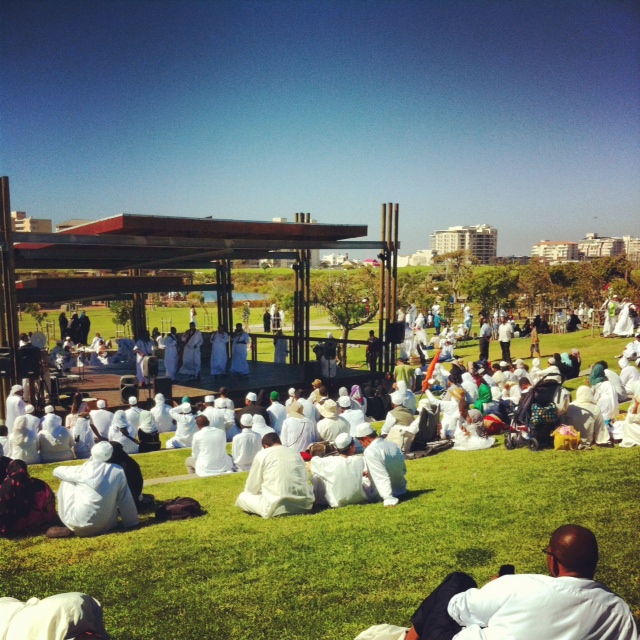
Green Point Urban Park amphitheatre.

On a blustery Sunday late last summer the girls and I had cabin fever so we decided to take a stroll down the road to what we consider our back garden, the Green Point Urban Park. Long before we got there we saw throngs of people crossing the Main Road and streaming in. There must have been hundreds of men and women in long, white robes, their garments blowing out in the wind as they trekked down the long walkway with children and blankets and baskets in tow.

We stopped at a water fountain where an old man was leaning, watching a bunch of men on their knees bowing down in prayer. I asked him what the occasion was and he explained that it was Mouloed, the prophet Mughamad’s birthday, and a very important event in the Islamic calendar. We continued to wander amongst the crowds, following the music. On the grassy plain that stretches out before the amphitheatre families sat in relaxed reverence as a male choir sang songs of such astonishing poignance and beauty that the three of us stopped dead in our tracks and didn’t move again for a long time. I forgot to be self-conscious in my tatty denim shorts as I became part of the celebration and absorbed the voices ringing out in praise, a south-easter lifting and carrying them up to their God.

It was foreign and familiar in equal measures. Islam might not be my religion, but it’s my heritage, and one of the most precious sounds I’ve ever heard was when I returned to Cape Town after a long time away and suddenly, on the wind, I could faintly make out the unmistakable, mournful strains of the Imam singing the evening prayer. And I stopped absolutely dead and listened with all my soul because I was home. When I was a small girl my granny and grandpa lived on the top floor of a tall block of flats off Greenmarket Square. That was the sound I would hear through the open window as I sat perched on my granny’s kitchen counter, swinging my legs as she peeled vegetables, and to this day it fills me with gladness.

The first time I ever visited Bo Kaap in the early nineties (it didn’t have cool coffee shops and galleries back then) was when my friend Zulfa invited my boyfriend and I around for supper one Friday night. I am certain it was the first time I ever had supper in a not-white person’s house, and I was excited and a little bit nervous. She had been explaining ‘Bismillah’ to me, and wanted me to experience it in person. ‘Bismillah’ is the belief that whenever you feed people who visit your home, strangers or otherwise, you are honouring Allah and you will be rewarded in heaven. The food was every bit as wonderful as I had imagined, her mom having made every samoosa, daltjie and sweet pickle from scratch. We sat around their smart dining-room table and they treated us ungodly, pale strangers like honoured guests.

Zulfa remains my friend and one of the best human beings I’ve ever known and we still refer fondly to that night with her beloved mom and dad who have since passed away. And when we get together, as we did a few weeks ago (in one of those ultra cool coffee shops that line Rose Street now) we laugh so much our stomachs hurt when we say goodbye, and I wonder why I don’t talk to her every day because she is like tonic.

Sometimes when we take the girls and ourselves for a walk along the promenade at the weekend we’ll be lucky enough to encounter a Muslim wedding party with all its miniature brides and grooms, and it’s such an occasion and so ostentatious and proper and wonderful it really puts the rest of us and our blasé ways to shame. Because, really, what is this world without its rituals and formalities and dresses of shiny, white satin? We need this stuff to give life magic. Otherwise it’s just a series of grocery shops.

A while ago, coming down Lion’s Head, we found ourselves outside that little building that looks like a mosque but is actually the burial site of some very pious people called Saits (Zulfa told me) who were responsible for bringing Islam to the Cape. I’m not sure what it’s used for exactly, so far from everything, but I’ve always been attracted to holy buildings so I took off my shoes and went inside. You can immediately feel you’re not just in any old room. The air was suffused with incense and something that felt like grace. I took in the curly gold lettering and the stars and moons and the swathes of velvet and I felt a little bereft, having no religion to call my own and this one being so pretty. And I offered a prayer to Allah that he would watch over his lost children, too.

Zulfa. Need I say more?
My friend, Zulfa. Need I say more?

A Peacock Called Don Juan

Close friends of ours who moved back from London round about the same time we left Sweden recently bought themselves a beautiful house in Hout Bay with a moody mountain view and a handsome resident peacock. Having your own peacock strutting around on the the lawn at braais while all your friends go oh my god and post pics on instagram is fun for a while, but the fabulousness wears thin when, every day at 4am, the peacock takes it upon himself to perch high on a branch in his favourite tree and call out to all the valley that he’s in the mood for love. Especially since he is the only peacock in the whole of the republic and he has to make his voice travel very far to be heard by maiden birds across the miles.

Nobody likes to be woken up day after day by squawking, least of all the anaesthetist neighbor who really can’t afford to be groggy of a morning. So, a meeting of the neighbourhood was called to try to find a solution to the problem of the pining peacock. While words like ketties and shotguns were grumpily uttered, my friends’ next-door-neighbour is a fanatical animal lover and was aghast at the suggestion that any harm should come to this gorgeous creature. Instead, she offered to call in an animal behaviourist who would communicate with the peacock, explain the situation to him and try and reach some kind of compromise which would allow the humans and the bird to live peaceably together.

So, the animal behaviourist contacts Don the peacock (he told her his name, obviously) and they have a chat about this problem and she records his thoughts and feelings in an email which she then shares with all concerned. Unfortunately, as Don ‘tells’ his human co-habitants, he isn’t actually that keen on changing his M.O. He likes living in Hout Bay, he enjoys the human contact and since it’s imperative that he finds love at this stage of his life, he won’t be stopping his mating call anytime soon. Nor moving it to a later time slot because that doesn’t suit his schedule. In other words, tough titties for you. At that, the animal behaviourist explains to him that the consequences might well be dire, but Don takes it on beak and is willing to accept his uncertain fate.

Happily for everyone – especially Don – ketties and shotguns were never needed as, before things reached a head, the lonesome Casanova was relocated to Clovelly where peahens are plentiful, and in the shagging department this dashing fellow is now positively spoilt for choice. The anaesthetist is happy, as I’m sure are his patients, and while Don’s show-offy presence is missed at gatherings, everyone’s getting a good night’s sleep which is rather more important. And it’s just one of those insane stories that wouldn’t happen in too many other parts of the world, but it’s kind of par for the course down here in the wildest of wild wests where you couldn’t make this stuff up if you tried.

The Very Fabulous Don.
Don the peacock

The Great Imposter Complex

My favourite Facebook comment thread in the whole world by far is a conversation I stumbled upon about three months which was happening between a bunch of highly respected, serious South African journalists about how many times in their lives they have known absolutely fuckall about the topic they were supposed to be writing about and had to totally bluff their way through it. And it was amazing for me to hear because I feel that about 70% of the time – that I have no idea what I’m doing, that it’s by some bizarre fluke that I’m actually paid to write, and that it’s only a matter of time before somebody finds out the truth – that I’m a total fraud and will definitely be stripped of my title soon because what the hell do I know about anything?

The stories they told were funny – one had to interview this young scientist who had come up with a theory which disproved Steven Hawking (really), and she had to nod knowingly and pretend to understand what the poor man was saying when he might as well have been speaking Khazakstanian in dialect through a hosepipe on the moon. Another who is such an astonishingly gifted writer her words regularly stun me talked about how she’ll be in an interview with someone who is just about to deliver the one pearl of truth she’s been waiting for for the past hour and which, like Lebowski says, will hold the entire interview together, she interrupts and starts talking about herself and the moment is lost, never to be retrieved.

I do that regularly, and then get home with my little dictaphone and want to slap myself with my plakkie as I play it back again and again trying to guess what the top chef in the whole wide world was just about to say when I stopped him to tell him my very important story about gathering mushrooms in a forest in Sweden. My worst interview ever in my life was also my first, and it was with Alanis Morissette at the height of her crossness and fame, and instead of spending the night before doing proper research I went for a braai with my new boyfriend thinking that I’m great with people, I’ll just improvise and wing it, except by the time we got to the Bellville Velodrome on Saturday afternoon I was in such a state of terror and anxiety I started crying and begging to be taken home.

And worst-case scenario in the world (I think this was pre that India song where she thanks all the poor people for giving her an enlightenment poes klap and endeavours to be nicer), she sat so far away from me I had to squint to see her and shout my crappy questions in a half-hysterical falsetto, hoping my voice would travel far enough, and she answered every single thing with a monosyllable. Every single thing, friends. At one point (she was just starting her covers phase) I sang – I actually sang – Sting’s King of Pain to her. To Alanis Morissette. To this day I have no idea what possessed me. I think I was trying to break the ice or something. She just took another sip of her lukewarm chamoMEEL tea and stared at me with big eyes. The horror.

Anyhoo. I’ve become better at interviews, but not better at feeling like I really am a writer just because I write. I’m finishing off my second book which is about the Banhoek Valley and historic Cape Dutch homes, and for the past year and a half my photographer has been introducing me as the ‘author’. And every time, without fail, my head whips around to see Margaret Atwood walk into the room because I’m not an author, silly. Ja, I write stuff, but ‘authors’ – well, they’ve clever and everything. And I think it’s something a lot of us suffer from, whether we admit to it or not. I used to have a conversation with a surgeon friend about whether he was a surgeon yet. And while he was performing operations all day long, it took him a while before he became a surgeon to himself. At what moment (if ever) do you become the thing other people think you are, and how much fakery do you have to put in to get there?

I once read an amazing thing JM Coetzee said – that with every book he submits he’s terrified they’re going to find out the truth – that he’s been a fraud all along and his books are rubbish. Those words really hit home for me – that such a brilliant, talented individual who has proven himself time and time again can actually doubt himself is astonishing, and makes me feel less ridiculous when I have these insecure thoughts. I wonder why it’s so hard to give ourselves credit where credit is due, and find it almost impossible to say, ‘hey – I did that well. I must be pretty good.’ Maybe part of getting there is having more conversations like that one on Facebook where people admit to feeling the same way, and we all stop pretending to be on top of things when we aren’t and just go, fuck it, I am clueless right now, buddy. It would certainly make the world a friendlier place.