Please Don’t Show Up At My Dinner Party In Your Pyjamas

The trouble with we Capetonians is that we’re so immensely pleased with ourselves for living in one of the world’s top tourist destinations (try and find a B&B or hotel with a room in December) that some of us seem to think we’re rather above manners and common courtesy. We can be flaky, we have a flat-topped mountain. We can be late – have you seen Clifton 4th? In fact, we’re so fabulous we can not show up at all, and guess what – you’ll invite us again. And if we do deign to honour your invitation, there’s every chance we’re going to show up in tracksuit pants and Uggs because, fuck it, we have the
winelands, and we’re too cool to care.

While I love this city and its inhabitants more than the sky, we are a bit like those upper class Brits who wander down to breakfast with filthy jodhpurs and mud in their hair. Lady Muffy Tittlegob doesn’t need to make an effort because she’s third cousin removed from Prince Charles, and anyway, she inherited Shropshire. Even though no-one in the world knows (or cares) where Camps Bay beach is, that irrelevant detail doesn’t temper our smugness one little bit. And, unfortunately, this sometimes translates to something not unlike arrogance. A few weeks ago I attended a dinner party at the home of a Swedish couple who have made Cape Town their home. Since I know hosting a dinner party in Scandinavia is quite a formal affair, and nothing like here (where if you arrive at the allotted time your host will be at the Spar buying rolls and you might or might not eat six hours later), I knew it was important to be punctual and to scrub up somewhat.

Sure enough, when our hostess made her entrance with salon hair, spiky heels and an LBD, I was immensely relieved to have donned a black pant and used my ghd. Not so much the other guests who clearly weren’t au fait with the ways of northern Europeans, and while our host was the epitome of charm and good manners, I cringed with embarrassment as guest after guest showed up looking like they’d fallen off the couch, grabbed their plakkies and got caught in a wind tunnel before arriving at the front door. And I love me a plakkie and a tracksuit pant when I’m at home or DVD Nouveau, but when somebody has spent an entire day (or more) shopping and cooking, cleaned up, lit candles and made everything beautiful for you, her guest, the least you can freaking do is give yourself a spritz of Burberry and put on a nice shoe.

Worse still – the invitation was for 6:30pm. By 8pm one of the couples still hadn’t shown up nor rung to say they were delayed, so we were shown our places and invited to start. At 8:30pm, while the main course was underway, the doorbell rang and these two graced us with their presence. Not an apology was uttered as the table had to be rearranged to accommodate them (she had changed the seating so that there were no gaps). Sis, guys. That is just not okay. It’s worse than bad-manners – it’s sheer disrespect. And I was mortified by the shocking behavior of my kind.

If my husband, a chiropractor, doesn’t SMS every single patient the day before to remind them of their appointment, they don’t show up. They’ll call three days later, offer a weak excuse or none at all, and reschedule. Or call five minutes before to say it’s actually not going to ‘work’ for them today. These gaps in his working day cost him big time, but he loves his patients and wouldn’t dream of charging them anyway – as he probably should. We’ve had one or two occasions where we’ve both been exhausted and not in the mood but fixed up the house, shopped and cooked for friends and acquaintances only to have them call, one by one, to cancel.

And the worst story of all is of a friend who was newly broken up and depressed over New Year’s Eve, so she decided to cheer herself up and remind herself that she still had people who loved her by hosting a dinner at her new house. She spent a fortune shopping, decked out the table and cooked all day for her ten guests. You know how this is going to end, right? Not one person showed up. Not one. Just. Beyond. Hideous.

So, here’s the thing (and believe me, I’m also guilty of being indecisive and non-commital, but I’m working on it): if you’re invited to something, don’t say ‘maybe’ and then wait to see if a better thing comes up. Say yes, and then if Jay-Z and Beyonce personally invite you to a shindig on their yacht, you will go to the Spur with your gran if you’ve already made that arrangement. Don’t accept someone’s invitation and then leave two hours later for another event. It’s such bad form. And if someone invites you to dinner at their home, for heaven’s sake, arrive on time and change out of your onesie. Put on a lip, bring flowers and show a bit of respect for the person who’s been missioning all day to feed your face. It’s really not asking a lot.

The Trouble with Maids

There can be no relationship in the world that is trickier to navigate than that between a white South African and her black maid*. Without a doubt it is our comeuppance for apartheid, and if for one second we’d like to forget about those bad old days of segregated park benches, Precious, with her Pick n Pay overalls, is there to remind us that the past is not quite as far away as we’d like to pretend. After years alone in Sweden a large, non-self-cleaning apartment with an infant and a toddler and no family anywhere near while my husband clocked ten hour days at work, the thought of moving back to South Africa and having hired help was a joy the headiness of which I could barely fathom. Things like going to the supermarket without negotiating a huge, double pram through a blizzard and then dealing with two hot, furious children in snowsuits in the 25-degree celcius store – never mind being able to work uninterrupted and squeeze in the odd yoga class – sounded like luxuries beyond comprehension.

But, having been away from the country long enough to forget that there is a system in place and that things work a certain way I was completely unprepared for the reality of hiring someone who is, essentially, a serf with a bad attitude (wait – hear me out), and how the slave/madam relationship works down here. Enter Nosipho (yes, she of the samp-and-beans). Nosipho was amazing with my kids – amazing – as in, she would host tea parties on top of the jungle gym and build forts out of blankets in the garden, make fires in winter, fry vetkoek and, within a month (Leo that she was) she was besties with all the maids in the neighbourhood, and her and the girls had a rip-roaring social life. She was clever and ambitious and, despite unimaginable disadvantages, had done pretty well for herself.

But, Nosipho was pissed off. For good reason – her mother was a sangoma who was more interested in pursuing her career than caring for her young daughter, and as a result she was placed in compromising situations. Despite being a strict mother her eldest daughter succumbed to tik addiction and lived on the street, abandoning her baby son with Nosipho who was left to raise him. For this proud woman who, on a miniscule salary, had managed to buy her own house and furnish it very nicely, her daughter was a terrible embarrassment. But, strictly speaking, none of this was my problem. She had a good deal with me – short working hours; a generous wage (well – in South African terms); time off when she needed it and lots of extras, like a big grocery shop of treats for her and her family on a Friday. I was always buying stationary for a relative; taking somebody to the optometrist; fetching and carrying a cousin’s child who had missed the transport home from school. She needed a couch, she got it; her geyser blew, we had it fixed. Her brother died – we paid for the funeral. It was never-ending.

But, there was the small issue of my ancestors having destroyed the lives of her ancestors, and none of this made either of us feel any better. In fact, it made things worse. You know the psychology of charity? The recipients get resentful as hell, and this happened with us. She’d come into work in a filthy mood and throw her bag down on the chair. I’d tip-toe around her and try to stay out of her way (not easy when you work from home). Of course, as an employer, what I should have done was say, ‘listen, lady, whatever’s bugging you – leave it at home. You’re here to work; get on with it or get out.’ Instead, I’d make us a pot of tea and fetch a plate of Melissa’s rusks and invite her to sit down at the table and tell me what the problem was. Was it something I had done? Was she upset about something work-related? She’d dunk her rusks and glower at me while I shivered in fear and thanked her profusely for the great job she was doing, never mentioning the fact that she left work every day reeking of my Prada perfume and with three loo rolls and all the sugar siphoned in a jar in her leopard print bag.

See, while we sat in awkward silence, me obsequious and her, vengeful, invisible assegais flew over our heads; Verwoerd in his droning voice assured everyone that blacks would be ‘separate but equal’; my school fees were free while her mother had to find the money to pay. The weight of our shared history was too extreme be lifted by the elaborate lunches I would prepare for the four of us to sit down together and eat until I realized why she was always ‘cleaning the bathroom’ when the food was ready. She didn’t want to sit and eat with me, but she didn’t know how to tell me. It just wasn’t the way things were done down here.

Eventually when she let me down severely by not coming back from her Christmas holiday on the allotted day and ignored her phone and my thirteen messages which meant I couldn’t show up at my job I put on my big girl panties and told her she’d better be back by the next day or that was that. She didn’t show up the next day; instead she went to the CCMA and reported me for unfair dismissal. She didn’t have a case so nothing came of that, and I was happy not to have that bad energy in my house, but it was a big shock and a learning experience for me. I was devastated, and mourned the end of our relationship for a long time. I had made the fatal mistake of thinking, because we were in each other’s company all day and talked often and were involved with one another’s families, that we were friends. We were not friends. I was her boss and, because of my own issues, I managed our working relationship poorly. And I take full responsibility for that. But it’s not easy either, given the status quo.

This past Friday night we shrieked with laughter as my gay friends, Bruce and Nicolaas, told stories of their maid, Dorothy**, who is very religious and hates Nicolaas so much she won’t even say hello when she shows up for work. She also leaves them rude, demanding notes and conducts her faith healing business during work hours from their phone account. Another friend of mine comes home to find her bathroom smelling of bubble-bath and her bed, warm. Apparently when Xoliswa is done with the ironing she enjoys a hot soak and a small nap. And, honestly, she probably deserves it. A colleague’s maid, Mavis, comes into work in the morning, makes herself tea and six slices of toast and watches Judge Judy for an hour before she starts with the vacuuming.

And the reason why nobody complains and our relationships get confused is because we know very well what a good deal we are getting. We have people do all our dirty work all day and pay them barely enough to survive. And because everyone else does it we pretend it’s okay. We say things to each other like, ‘R4000 a month is a lot for them. They live on very little.’ Really? Do ‘they’ have any choice? Last time I checked groceries and school fees and petrol cost the same for everybody, irrespective of their race or job or socio-economic position (and this is not a white-people-being-bad-to-black-people thing, the wage for domestic help is the same, whatever racial group happens to be hiring).

Anyhow. I don’t hire anybody full-time anymore. You can’t have a heart and not get personally involved with the people who are virtually living in your home, and it’s just too hard and complicated. I don’t have the mettle to draw boundaries and be tough with individuals whose lives are insurmountably difficult while mine is one long exercise in privilege. I have a char once a week, and the rest of the time I do my own dirty work. And maybe I’m denying somebody deserving a job, but at least this way my sanity remains intact. Eish, it’s a helluva thing.

*I know this term is not politically correct, but I’m going to use it anyway because ‘domestic worker’ just doesn’t work and ‘housekeeper’ is pretentious.

** Since this article was written Dorothy fired Bruce and Nicolaas. If anyone needs faith healing, drop me a line and I’ll get you her number.

Going Stone-cold Sober for a Month

A few Saturdays ago I went to a friend’s dad’s memorial at a pub in Obs. It was lunchtime and my house was full of workmen and the morning had been chaotic, and as I drove there I thought to myself, ‘I’m not going to drink today; I’m not in the mood – I’ll just have a diet coke.’ I’m not a good daytime drinker – alcohol at lunch makes me grumpy and hungry, and I knew I’d have to go home and deal with painters and kids. ‘Yes;’ I thought. ‘What a good plan.’ So, in the door I walked, said hello to friends, and then was asked if I’d like a draught. And immediately I said yes. I drank it down, and then, inexplicably, had another. And worse – I harangued a friend who did have a coke because he was going surfing later. The beer made me grumpy and hungry, as I knew it would. I went home and had to deal with painters and kids. I drank water and coffee but it didn’t help; I felt blech and my day was kind of ruined.

And you have to ask, what the hell? What is this about? And I think, simply, habit. It’s a habit to drink. Sometimes alcohol is lovely and tastes delicious and improves your mood and your day, but sometimes it doesn’t. And yet it remains really difficult to just say no. It took moving to Sweden to realize that we South Africans are a thirsty, hedonistic bunch. For dinner parties at home we’d cater roughly a bottle of wine per person, only to find our friends wanted water and milk and soft drinks. Which meant we drank it all up ourselves and had a rip-roaring time, but really. I’d go for lunches in groups and be the only one ordering Chardonnay. Eventually it got embarrassing and I stopped.

But we South Africans do drink a lot. We do a lot of things a lot. I suspect it has something to do with how we live down here, and how kind of nuts and Wild West-y it is. Life is lived in technicolour – we work hard and play hard, and while I wouldn’t change it for the world and I love the spontaneity and the aliveness, I do think my relationship with alcohol could bear a little scrutiny. Why do I drink when I don’t really feel like it? Why is it easier to accept a glass of wine than admit I’d rather have a lime and soda? And then, if we want to take the argument even further, why do we need the social lubricant in the first place? Don’t we like each other enough to sit around a table and chat and catch up on our lives without being half pissed?

Last Sunday was an interesting experiment. I had lunch with two close girlfriends, both of whom love their wine. Since we’re doing Sober October together nobody was drinking. I’m sure it was the first time I’ve had lunch with either of them where alcohol was not involved. We had grapefruit ‘cocktails’, and then they had a non-alcoholic beer each and I stuck to soda water and lemon. We ate a beautiful rib stew in the sunshine, talked non-stop, shrieked with laughter and two of us literally fell off our chairs. It was a wonderful afternoon. Then we drove home without feeling sleepy from wine or worrying about a roadblock somewhere along the way. Because even if you wait till you sober up before you drive you’re never completely sure you’re within the limit.

For the past two weeks I’ve been in a vague state of panic over a birthday party I’m attending at my favourite venue this coming Friday. Because it’s one thing socializing with people who are also refraining from drinking and you’re all smug and in cahoots, but being in a smoky bar where waiters keep offering you another glass of champagne (my favourite) will be another story. Still – even though I’ve never been a huge drinker (at varsity I was always the semi-sober one who went home first), and three glasses of anything are my absolute limit – I feel that this is a good exercise to undergo. Not just to give the old liver a break and to drop a few pre-summer kilos, but to see whether all this booze is really necessary. And to observe myself in a social setting without the help of a drug. I had a meeting with a teetotal sound engineer a few months back who was telling me how much people’s voices change when they drink. Once, as an experiment, he used sophisticated sound equipment to record people speaking before they had their first drink and then as they consumed more alcohol, and he said it’s incredible how our voices get lower and slower till eventually we’re almost unrecognizable. Kinda scary.

For me, there are few things more pleasurable than a glass of good wine at the end of a long day. Or, an icy cold beer when you’re hot and thirsty and harassed. It gladdens the soul and relaxes a mind that’s been in overdrive all week long. And it just takes the edge off like nothing else. I refuse to believe that when drunk moderately and mindfully alcohol is a bad thing. It’s the other way that’s not so great – when we do it because we do it or because other people or doing it and it’s the default option. And it’s particularly bad when it’s a daily crutch or we have so much we make ourselves sick or when we become aggressive and unpleasant. And so far I’ve missed it much less than I expected. In fact, I’ve not missed it at all. After this experiment I might opt not to drink in the daytime anymore. Or, only very seldom when it’s a special occasion or I’m on a certain friend’s deck where a glass of vino and happy times just go hand-in-hand. And while I’ll never give up wine, it’s been good to give up wine for a while. Just to see how life feels without the insulation. Pretty good, actually.

Where is Miley’s Mother?

I know we’ve all had it up to here with Miley Cyrus hype, but this morning as I looked at the shoot she’s just done with Terry Richardson (http://www.dailymail.co.uk/tvshowbiz/article-2442749/Miley-Cyrus-simulates-sex-Terry-Richardson-shoot-swipes-Sinead-OConnor.html) all I could think was, where the hell is this child’s mother? Because if there is anyone in the world who loves you enough to take one look you pulling some bizarre underwear garment up so high that you reveal your labia majora to the world and slap you upside the head for your goddamned idiocy it’s the woman who birthed you.

My mother has always been the most amazing champion of my career. When I was just starting out as a writer and the only person who would publish me was the editor of Hustler magazine (I wrote ironic articles about things like feminism under a male pseudonym), she would go and buy a copy and black out the naughty bits and show her friends at work. But, proud as she has always been of me, I can say with absolute certainty that were I to take my clothes off in public and simulate sex with a bear, she would be sad and disappointed beyond – and let me know about it.

Maybe this is my age speaking, but when I see Miley’s emaciated body and huge, blue eyes staring at the camera ‘sex symbol’ is the furthest thing from my mind. What I think is, ‘darling child, what have they done to you?’ As I’m sure Sinead did when she sat down and wrote her letter. I see a troubled, confused young woman who has lost all sense of perspective and must value herself very little. And I remember myself at that age, and how vulnerable young women are, and what an exploitative place this world is. But somehow, because she is Miley Cyrus, and we think celebs are above normal standards of decency, we get confused ourselves and start questioning our own values and think because she’s doing it it must be okay.

And this is where moms come into the picture because no amount of Hollywood/fame/money/stardom would prevent me from dragging my 20-year-old daughter from that photo shoot by the ear. It would be over my dead body that she would demean herself in that way, and the horror that I had raised her so poorly would be devastating and make me question every decision I’d ever made with regard to her upbringing. And I wouldn’t give a crap if she was 20 or 25 or 35 for that matter. ‘Grown up’ means nothing to a mother. And then, as I looked at those pictures of her holding a beer bottle in a suggestive pose and doing all manner of lewd and lascivious things, I realized how lucky I am. Because when I became too arrogant to think my mother had anything more to teach me, I went to an institution of learning where I was surrounded by strong, powerful, brilliant women writers and intellectuals who changed who I was by illuminating the subtle machinations of the patriarchy and showing me how much I had to offer.

And from there I got my first job at a women’s magazine whose all-female staff included some of the brightest, most astute women in this country, and much more than my seniors, they became mentors to me who, with their collective cleverness and life experience, filled in whatever gaps were missing. What these ‘big sisters’ taught me was invaluable, and I guess the point I’m making is that, whichever way you look at it, we live in a man’s world and in order not to get lost in it, young women need this type of guidance; they need mentors to show them that they’re valuable and clever and worthy – otherwise it’s too easy to persuade them that swinging naked on a large, metal ball is a good career move.

I guess because of her fame and her money Miley missed out on this important life stage. She must not have had the advantage of female elders – grandmothers, aunts, big sisters, whatever – to guide and affirm her, and assure her that she is a valued member of her community. No woman who feels safe and loved would do the things that she has done of late. It speaks of a generation of lost daughters; girls who enter adulthood with a deeply warped sense of what it means to be a woman. Exactly at the time we should be achieving power and the balance should finally be tipping in our favour, we have somehow veered off course and lost sight of the things our sisters fought so hard for. This whole thing has been a sad moment for women of the world. It would be nice to dismiss it as every part of ridiculous, but too many young girls (my daughters included) look up to Miley Cyrus not to take it seriously. Her mother should have stepped up to the plate. Mama Cyrus, you’ve let your girl down.

On National Braai Day

The guy on the right is a photo bomber. It was Oupa Bekker, on the left, whom I was surreptitiously trying to capture.

There are a number of things a city slicker can learn at a potjiekos competition smack in the middle of the small Karoo – that ‘Suurings’ (those little yellow flowers with the sour stems we used to eat as kids) go very nicely in a waterblommetjie bredie; that creamy, cheesy, bacon pasta is outrageously good done over the coals, and Oupa Bekker, whom Herman Charles Bosman immortalized in his famous short stories, is alive and well and living somewhere near Montagu. Not only Oupa Bekker, but Gysbert van Tonder, At Naude and a whole host of beloved Groot Marico farmers showed up at the Makiti Montagu Heritage Potjiekos competition and put away scary amounts of Klippies and coke while they sat in the sun, stoked their fires and made pots of succulent springbok (shot by themselves, naturally) cooked with locally dried peaches; chicken and smoked pork, and seafood stew packed with perlemoen to be eaten with bread baked on the coals. There’s not a lot you can tell these men about cooking meat over a fire.

This was the first year the town of Montagu hosted the event, and I don’t remember when last I had so much fun. For R50 you got a very nice (read: large) wine glass, a packet of olives and entry into the tasting tent where wine makers and their reps were only too happy to fill your glass three times with your tipple of choice (mine was the caramel-liest Chenin Blanc I’ve ever tasted) while you swanned around the food tables helping yourself to hunks of ciabatta dunked in olive oil and dukkah, chilli and mint haloumi fresh off the grill, and olives flavoured, chopped and prepared every way you can imagine. While a lady from Brackenfell with very red hair sang eighties covers, we wandered around the marquees, wine bottles in hand, offering cooking tips to the beefy, good-natured farmer-chefs who have no doubt been preparing kudu and making potjie since before we were born.

What’s more, once the judges had announced the winner (the waterblommetjie bredie with Suurings), we took the liberty of traipsing around with our plates, tasting some of the amazing dishes that were rustled up that afternoon, and in the warmth and friendliness that was evinced between competitors and their families in the heat and dust of a Sunday afternoon somewhere in the semi-dessert I felt some sort of pang of something; a nostalgia and a sadness around what was and what will never be. You take one look at these oversized men with their enormous limbs and sunburnt faces from years of outdoor toil and you know that they are what they are. Alone on their vast tracts of land under a huge blue sky, our not-so-new South Africa has little bearing on their lives. Whether I agree with their views or not, I understand how they think. Like the real Oupa Bekker, they are relics of another time and place.

And for better or for worse, this afternoon of potjiekos and boeremusiek is what Heritage Day means for a lot of people living in South Africa. For others, it means a well-deserved day off work, and a bus ride to a stadium where there will be beer and braaied meat and speeches and songs and vuvuzelas. Muslim families will take their soft drinks and home-made samoosas and pies and daaltjies to the Green Point park where they will rest and chat and absorb the sun while their children climb on the jungle-gyms and run across the grassy expanses. We, white liberal(ish) intellectuals will gather on a deck in a trendy part of town and enjoy good wine and fancy salads and expensive cuts of meat. And that’s how this country is. In my hugely sentimental and highly unlikely fantasy version of South Africa, where there was no segregation – legislated or otherwise – we South Africans would be a bunch of brown people who spoke a combined Xhosa-Afrikaans-English dialect and shared a unique, hybridized culture which consisted of elements of all of us, and race would be irrelevant and assets shared.

Instead, we have our ‘pockets’ and our clans and our ways, and there is about as much chance of the vuvuzela folk showing up to make a skaapboud potjie as there is of the Karoo farmers heading to a stadium to dance and toyi toyi and sing. And I don’t imagine this will be changing anytime soon. Which is why most of us distance ourselves from the word ‘Heritage’ and any notion of oneness that this might connote and re-name it National Braai Day, as some folks suggested we do a few years back. Because in spite of centuries of living separately and having no national culture to speak of, what we can agree on in no uncertain terms is that we South Africans are partial to meat cooked outdoors over the coals. And maybe, for now, that will have to do.

Belia's brother-in-law, Ben, pushed the boundaries with this chicken, smoked pork and chorizo extravaganza. It didn't win, but it should have.
Our friend, Ben, pushed the boundaries with his chicken, smoked pork and chorizo extravaganza. It didn’t win, but it should have. Here, Belia and I pretending to have made it ourselves.

On Tie-dyed Pants and Patchouli

I’ve been doing yoga for a long time, and over the years my teachers have been a diverse bunch, ranging from a deeply introspective yogi who spent a year naked on a hill in Kashmir (really) and insisted his students wouldn’t benefit from the practice unless we did four grueling 2-hour classes per week, to my current one who is a cuddly, beer-quaffing guy in baggies who says things like, ‘chakra schmakra, whatevs,’ and is just happy when people show up.

And what strikes me is that, while I enjoyed the seriousness of the yogi’s class and being all righteous and ohm shantied of an evening, the guy who arrives in shorts and a t-shirt and smacks his hairy stomach before telling us to put our ‘tits to the floor’ is every bit as good an instructor as the other guy who walked around during Shavasana throwing water from the Ganges on our heads.

And it’s a funny thing about us humans – give us half the chance to be vain and pose-y, and we’ll grab it with both hands. I know myself – when I go to yoga in my turquoise Lord Ganesh vest with matching beaded necklace, I am instantly more enlightened. If I happen not to be wearing makeup that day – hell, I’m practically Baba. And it’s particularly ironic in light of what yoga practice is supposed to be about – humility, self-awareness, acceptance and detachment. But, who doesn’t stare at the next ou and think, shoo – now that is a kak downward dog, my friend. Or, no, lady, you really need to think about getting a pedi. Like, yesterday.

We love judging, comparing and bolstering our own egos, and there can be few people more lacking in self-irony than the kind of instructor who shows up in tie-dyed trousers, reeking of patchouli and doesn’t even bother to hide her disdain for we pitiful mortals who can’t do the head stand and probably ate bacon for breakfast. And if the instructors can’t leave their egos at the door, what hope do the rest of us have? I guess it’s a good example of the adage, ‘we teach what we need to learn.’

Unless you do have nothing better to do than be naked on Kashmiri hills, it’s pretty tough managing eight hours of yoga a week, never mind following the recommended diet of lentils, water and air. And that’s okay. That life is not for everyone, and who wants to give up Chardonnay? While we are all suckers for marketing, and beer-loving guy opts not to wear purple harem pants and a rose quartz headband, what he gets right is his enthusiasm for this beautiful art, his sense of humour and his refusal to put himself on any kind of pedestal. He’s a just a dude who believes in yoga and wants to share the love. And, isn’t the most important thing that, instead of watching the Kardashians over a bucket of KFC, we’ve shown up with our little rubber mats and are willing to stretch and sweat and learn?

So, to my mind, the best teachers are not the ones who fasted in Bengal and flagellated themselves with banana leaves (though they’re certainly an interesting bunch), but those who remind us to leave our judgements and prejudices at the door; that we are all flawed and ridiculous and, at the end of the day, more alike than different. And if we could all remember this and live our lives accordingly, the world – and it’s yoga classes – would really be miles more fun.

Hello Hunger, My New Friend

A few weeks ago a girlfriend of mine went to see her GP because she had gained a crazy six kilograms in a few short months and she thought something must surely be wrong with her. Happily, after a series of tests her health was given the all clear; less happy was the verdict: it was the chips and pepperdew dip wot done it. Like a lot of us, she’d simply been eating too much. For someone who’s enjoyed a lifelong love affair with food, these words aren’t fun to hear – after all, life without wonderful food would be an intolerable business. But we eat too much wonderful food and we get fat and that’s not fun, either.

What her GP pointed out is that every four hours or so our bodies send a message to our brains that we are low on energy and need to refuel. And, as evolutionary beings, we don’t like the feeling of hunger so we go looking for a toasted cheese sandwich post haste. Except, for most people who lead relatively sedentary lives, this signal is a bit of a porky. Yes, your tummy might be empty, but unless you recently ran the Comrades, you actually have loads of glucose stored in your liver and fat cells, and circulating in your bloodstream. In fact, if someone locked you up with no food (unless you had an illness like diabetes) you could survive on water for quite a long time.

As Mr GP insists, while hunger doesn’t feel pleasant and eating a toasted sarmie does, there is no physiological reason why we need to respond to that signal right away. So, when we feel a bit hungry, we should try having an apple and a glass of water, and then wait a bit, and those pangs will more than likely go away or, at least, diminish. This is not to say we should stop eating or replace all meals with apples and water, but rather be mindful of the fact that the sensation of hunger is not always an accurate indication that our bodies require food. You know how when you have a huge dinner you wake up starving? Case in point. Your brain is a big, fat liar, but your skinny jeans know the truth.

So, as someone with the appetite of a hard labourer who has been known to out-eat large men even though I do nothing more strenuous than carry my iPad from room to room, I decided to try not to respond to the hunger signal instantly. And I cultivated this inner dialogue that went something like this: (stomach rumbles) ‘oh, really? You’re peckish? So, the two million calories in last night’s Bloody Marvellous Mushroom Risotto weren’t quite enough to fuel all this hard typing you’re doing this morning? Well, tough titties for you, greedy guts! You can have one cherry tomato, exactly. So, put that in your fat little pipe and smoke it!’

And, to my astonishment, I didn’t faint or expire during the course of the morning. When my tummy did the rumble lie, I gave it a cup of green tea. It wasn’t happy, but really, what was it going to do about it? For lunch I had salad with avo and seeds, and for supper, I reduced my normal portion by a third. It’s a challenge, not shoving stuff in your mouth the second you feel snacky. Or bored, or meh. But I got kind of used to it – the sensation of being slightly hungry and not doing anything about it.

And I actually felt pretty light and energized. Because we do weigh our bodies down and tax them with the sheer volume of food we put away every day. Google how to live longer, and a lot of studies will tell you simply to eat less. There’s a marked correlation between frugal eating and longevity. The process of consistently digesting rich, protein-heavy food takes its toll on the human body, and eating, for us, is at least as much about recreation as it is about nourishment. Doing away with all lovely food and always eating leaves would make (my) life not worth living, but there is an argument for not turning every meal into a feast. Choose your feasting times, eat like a crazed Roman, but the rest of the time (more or less) it just makes sense that we’d all be better off with small portions of simple, easily digestible food.

So, after five days of eating air with a side of nothing we went out for a fancy dinner (hooray! A feast, at last!). Normally I would easily put away three courses, but after my starter thimble of cauliflower soup I was so full I had to take my entire main course home. And while it’s boring as hell being one of ‘those’ girls and my husband’s eyes were rolling to the ceiling, at the same time it did tell me that I’ve been eating hopelessly too much forever, and that it’s not by some tragic fluke that my muffin tops spilleth over. Whether I’ll be able to change a lifetime’s bad habits is another question, of course. Once the novelty of being hungry and smug wears off, there’s a good chance I’ll be right back on the mayo samoosas*. But I’m going to try to try. Really.

*(I discovered a sad thing when I was fifteen and my boyfriend’s mom used to buy a box of frozen samoosas which we would proceed to deep fry and devour: a hot samoosa goes very, very nicely with Helman’s mayo. As if the fat content of the thing is not enough. Don’t try this at home, you’ll never eat them any other way.)

On Moving Back to South Africa

A good place to remind yourself to let go and let it be.

When I moved back to South Africa after spending nearly a decade in northern Europe, it was with no small measure of shock that I realized I had forgotten how to live in this country. It wasn’t just the small things like not knowing where to buy stuff or at what age kids here go to school – it was a culture shock which took me entirely by surprise, having longed and yearned for home during most of my time away. In retrospect, what happened was that I lost my tough outer shell.

During those years of living in a place where egalitarianism is the norm; where nobody goes hungry and almost everybody had a roof over their heads, the thick skin you need to live in South Africa had grown soft. I couldn’t cope with the children begging at the traffic lights and the thin women with babies who knocked on the front door asking for food. Once, in Pick n Pay, I found myself behind a woman with two things in her basket – pilchards and rice. That was obviously all she could afford. Yet, she continued to walk up and down the aisles as if, magically, the contents of her wallet would increase the longer she hung around. I had to leave the shop; I couldn’t bear it.

I gave to everyone who asked me. In those early months I parted with vast sums of money. One morning I gave an old man nearly blind with cataracts R500 so that he wouldn’t be evicted from the room he shared with his son. I would stand behind people in queues and pay for all their groceries. I was in despair, and utterly outraged by the wealth surrounding the poverty and the collective blindness everyone down here seemed to practice. I shook my head at the people waving the children away from their 4X4s – as no doubt my friends shook their heads at me, wondering how I was ever going to survive living back in this country.

Then, slowly, I became immunized like everybody else. I started being more selective about who I helped; stopped taking every sob story at face value. One day a man whose groceries I was paying for asked me to hang on a second and dashed off for five minutes, coming back with wine, salmon pate and imported crackers. I hired somebody to clean and look after the girls. Before I knew it I was attending meetings with her grandson’s school principal; buying stationary for her cousin’s child, bankrolling the entire family and – by the way – being taken for the biggest ride. Slowly I started to realise I was behaving like a total imbecile, and if I couldn’t come to grips with my white guilt and accept South Africa for what it was I would be better off living in Perth.

Eventually, I stopped giving to people on the street. I guess I got tired of it – the constant, relentless need and the tales of woe coming at me each time I walked out my front door. And the gaping black hole no amount of R5 coins will ever fill. At first I was horrified by this callous version of myself. Now I’ve made peace with her. There is no other way. Random acts of kindness just don’t work down here. You need to get over yourself and understand where you’re living. The complexity of our socio-political context is impenetrable to foreigners, and you have to have lived here a long time to get it. It’s everything and nothing to do with race and colour. It’s the wild west where dog eats dog and survival of the fittest is the ethos you have to practice, even while you’re acutely aware of the injustices. It’s brutal, and you have no choice but to be as tough as nails.

You make a decision about how you’re going to give, whether of your time or your money, and then you draw the line. You pay people well, care about their families and behave like a decent human being, but you institute boundaries and you stick to them. And, paradoxically, South Africa remains the warmest, friendliest (dare I say ‘happiest’?) country I’ve ever been to, and I’ve been to many. I live in a road with a couple of B&Bs. I’m regularly accosted by tourists who want to tell me how much they love my country and its people – how they’ve never encountered such warmth and generosity of spirit and that they can’t wait to come back. And I have to agree – it’s a crazy place, but it’s beautiful and vibrant and alive. It buzzes with a kind of energy that makes me feel like I can do anything I choose. And what I probably love most of all is the freedom and the open-endedness of life down here; there is something which makes the human spirit sing. A sort of wonder at being alive which Europe – for all its fabulous old buildings – lacks. For reasons I can’t really qualify, it seems to fill people with joy.

So, what I’ve learnt over the past four years is that I can’t save Africa and, frankly, I’ve started to wonder whether it needs my saving. A while back I got a whatsapp from a friend who receives daily words of wisdom and counsel from a sage by the name of Abraham, and it was a message that challenged the way I see this country. It said, what if there is nothing ‘wrong’ with South Africa? What if it simply operates by a different set of standards and norms? What if the ‘problems’ are about us and our perceptions and that there is nothing, in fact, to fix?

Of course I interpret this in my personal paradigm that nothing is random and that this earth realm is the school of hard knocks. We come here for a certain type of experience, and we choose our setting accordingly. No, this doesn’t exempt us from doing the right thing and giving whatever we can, but it does serve as a type of reminder not to take too much to heart; to step back a bit and observe rather than taking everything on as a personal battle. Practice love. Be a good human being. But, it is what it is. It was the a-ha moment I’d been needing all along. You don’t always have to understand things to love them. Sometimes it’s the complexity and the mystery that create the firmest grip on our hearts. We all have different ways of interpreting our truth, but I felt like I ‘got’ it at last. And what a relief to lay down my panga.

On Feeling Utterly Lost for No Particular Reason

So, I’ve been racking my brain to come up with a blog idea for today, but nothing wants to ‘stick’ because all I can think of is how utterly lost and miserable I feel for no particular reason. Then late last night I got a message from my friend in Sweden saying how much she loves the ‘real’ pieces, and how they resonate for her, so maybe this blog needs to be about that. I’ll run with it see where it takes me. If nowhere, at least I’ll get a good cry out of trying.

The thing is, in this linear, scientific, cause-and-effect world we’ve created for ourselves, things need to have reasons, and that’s why times like these – when you want to crawl in a ball and have everything go away but you can’t say why, exactly – are so bewildering. You can’t ‘just’ feel stuff. You must be able to explain it. And I guess there are reasons – there are usually lots of them, but they’re not always as obvious as we’d like them to be. For me, one is definitely about not having a place to go to in the morning for the first time in quite a few years. And while I have no doubt in my mind that I needed to leave where I was and spread my wings and do something new, the reality of an empty day alone at home scares the living daylights out of me.

It’s fun to stay home when you’re supposed to be at work, but we under-emphasize how reassuring the structure of a day in the office is. I like people, and the nonsense (and sometimes serious) talk you have with colleagues – those individuals you find yourself spending many hours a day with and get to know and love. I liked making them laugh and being used as an agony aunt, and the little office rituals related to birthdays, new babies and resignations. It’s not really me to spend this amount of time alone. And, while I am working harder probably than I ever have, I’m not getting paid for much of it, which totally confuses my brain. Does it still qualify as work? By what rights do I get to sit here and talk about libraries when I should only be doing stuff that pays?

So, it’s that plus coming down from the high of starting the blog and having people read it and like it and the unmitigated affirmation that gave me, but then realizing that the gazillions of work opportunities I’d hoped would magically open up, didn’t, and then even more of a sense of what the hell am I doing? What is my next career move? Surely I need to have some sort of plan for myself; some ‘direction’ if I’m to be allowed to exist on this planet. We human beings have a really hard time just being. So, I need to try and change the focus from what the blog will do for me to the real reason I started it – for the simple, unabashed love of stringing words together.

Yesterday one of my closest girlfriends sat next to me on my couch and held my hand while I blubbered and said to me, ‘you are doing this for you. And yes, you are reaching people and making them think, but you are doing this for YOU.’ And she is right, of course. It’s a solitary pursuit and it can be lonely as hell but there is nothing else I really want to do. So, I’m going to try to remove (or at least acknowledge) the pressure I’m placing on myself, and let this process take its course.

And, maybe hardest of all, is giving myself permission to feel lost and lonely and scared without a ‘good’ reason. No, nobody in my life has died; yes, I have people who love me; no, I am not homeless; yes, I have everything I need. But I still feel fucking horrible and I can’t explain why. Maybe I’ll feel better tomorrow, and maybe I won’t. Maybe this funk will take a while to lift, and maybe that’s okay, too. Perhaps we don’t have to feel happy and together all the time and put up a façade that everything in our lives is fabulous when actually we feel seven years old and want our moms. My name is Susan and I feel sad, and there’s no ‘because.’ That’s all.

On Libraries and Life

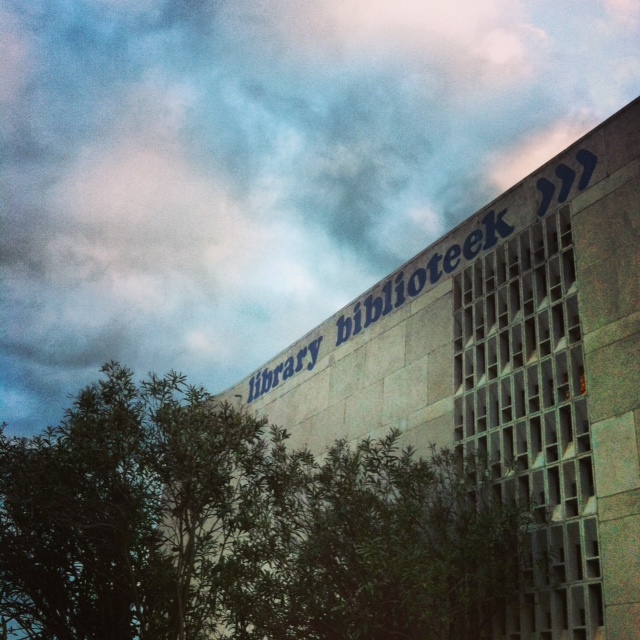
Sea Point library.
Sea Point library on a winter’s morning.

On my very first day at university as I found my way to the library on UCT’s labyrinthine upper campus, I spotted a poster stuck just outside the door. It read, simply, ‘The Doors of Learning and Culture Shall be Opened.’ Today, those words would spark the faculties of critical thinking I was to develop during my years at that institution and I would immediately think, ‘whose culture? What does ‘culture’ mean? Who are these doors opening to?’ but back then, they stopped me dead in my tracks and I distinctly remember tears of awe and gratitude filling my eyes.

Because I had been a terrible High School student, skipping classes as often as I could get away with, doing the bare minimum of work and not taking one damn thing my teachers said seriously. While in my final year I half-heartedly tried to make up for lost time and get a university pass, it was too little too late, and I’d pretty much messed up my chances of getting accepted. But, the universe works in mysterious ways, and somehow someone in UCT’s admissions office must have thought there was a glimmer of hope for me and I got the acceptance letter in the mail (I wish I still had it – it changed my life), and then I was there, walking through those hallowed doors of learning and culture which, by some miracle, had been opened to me.

I never took that privilege for granted. While other students partied and drank, I’d had my share of that, and I knew my time had come to show them what I could do. I worked hard and got firsts for everything. I couldn’t get enough of learning. I listened intently to what my lecturers said; I ate the wisdom they dished up to us, their hungry, hopeful students. I had found my place in the world, and it was within the grey corridors of the English department where daily I would pass the offices of J.M. Coetzee, Andre Brink, Stephen Watson; writers and thinkers who, through words alone, changed the landscape of South Africa. Those were happy years for me. I was home.

Yesterday, as I stood in Sea Point library waiting to return some overdue books, I thought of UCT’s library where I spent so many happy hours poring over mind-bendingly beautiful combinations of words; hand-writing essays (we had no laptops in those days); studying for all I was worth. Libraries smell and feel the same wherever you are in the world. There is a church-like quality about them, even when they’re shabby and low on funding and most of the people visiting them look as worn as the newspapers they sit in a corner and read. When I go to my local library I see a segment of the population I wouldn’t normally, and when my favourite librarian is there – a softly-spoken, bespectacled man in his fifties – suddenly there is time in the day to talk about books and authors. In that musty-scented stillness the bustle of life comes to a halt.

On that day, an Irish woman in her sixties was ahead of me in the queue. She was happy because the book she’d been waiting for, Freddie Mercury’s biography, had finally arrived. It was three weeks late, and every day after work she would come by to see if it had been returned. She told me she was his biggest fan, and knew all of his lyrics by heart. I told her my husband used to work close to Freddie’s home in London, and when the news broke of his death he was one of the first people to put a rose outside the singer’s door. She smiled broadly at that story.

Then, the bubbly, young librarian who was working the evening shift reminded her that she had promised to sing a Freddie Mercury song the day her book arrived. ‘Oooh, that’s right,’ she said, in her lovely, lilting accent. ‘Hang on – I was just listening to it in the car – ‘I see a little silhouetto of a man/ Scaramouche, Scaramouche, will you do the fandango?’ And then, quite spontaneously, an old guy standing nearby in a trench coat and I joined in with, ‘Thunderbolts and lightning/ very, very frightening – me!

We chuckled, said goodbye and I headed out into the dusk to my house with lots of rooms and noisy children and cooked a butternut curry, and the Irish woman went home to her house with her book and probably read it while she ate supper and the old guy in the trench coat went off to his life somewhere else. People say print is dead and that soon there won’t be any more books. I hope they are wrong because that will mean no more libraries, and libraries are places of magic.