On Islam and Cape Town and Friendship

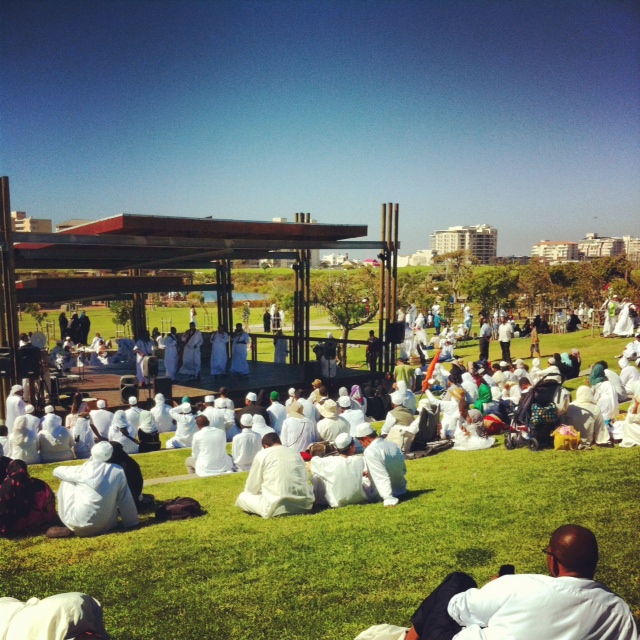
Green Point Urban Park amphitheatre.

On a blustery Sunday late last summer the girls and I had cabin fever so we decided to take a stroll down the road to what we consider our back garden, the Green Point Urban Park. Long before we got there we saw throngs of people crossing the Main Road and streaming in. There must have been hundreds of men and women in long, white robes, their garments blowing out in the wind as they trekked down the long walkway with children and blankets and baskets in tow.

We stopped at a water fountain where an old man was leaning, watching a bunch of men on their knees bowing down in prayer. I asked him what the occasion was and he explained that it was Mouloed, the prophet Mughamad’s birthday, and a very important event in the Islamic calendar. We continued to wander amongst the crowds, following the music. On the grassy plain that stretches out before the amphitheatre families sat in relaxed reverence as a male choir sang songs of such astonishing poignance and beauty that the three of us stopped dead in our tracks and didn’t move again for a long time. I forgot to be self-conscious in my tatty denim shorts as I became part of the celebration and absorbed the voices ringing out in praise, a south-easter lifting and carrying them up to their God.

It was foreign and familiar in equal measures. Islam might not be my religion, but it’s my heritage, and one of the most precious sounds I’ve ever heard was when I returned to Cape Town after a long time away and suddenly, on the wind, I could faintly make out the unmistakable, mournful strains of the Imam singing the evening prayer. And I stopped absolutely dead and listened with all my soul because I was home. When I was a small girl my granny and grandpa lived on the top floor of a tall block of flats off Greenmarket Square. That was the sound I would hear through the open window as I sat perched on my granny’s kitchen counter, swinging my legs as she peeled vegetables, and to this day it fills me with gladness.

The first time I ever visited Bo Kaap in the early nineties (it didn’t have cool coffee shops and galleries back then) was when my friend Zulfa invited my boyfriend and I around for supper one Friday night. I am certain it was the first time I ever had supper in a not-white person’s house, and I was excited and a little bit nervous. She had been explaining ‘Bismillah’ to me, and wanted me to experience it in person. ‘Bismillah’ is the belief that whenever you feed people who visit your home, strangers or otherwise, you are honouring Allah and you will be rewarded in heaven. The food was every bit as wonderful as I had imagined, her mom having made every samoosa, daltjie and sweet pickle from scratch. We sat around their smart dining-room table and they treated us ungodly, pale strangers like honoured guests.

Zulfa remains my friend and one of the best human beings I’ve ever known and we still refer fondly to that night with her beloved mom and dad who have since passed away. And when we get together, as we did a few weeks ago (in one of those ultra cool coffee shops that line Rose Street now) we laugh so much our stomachs hurt when we say goodbye, and I wonder why I don’t talk to her every day because she is like tonic.

Sometimes when we take the girls and ourselves for a walk along the promenade at the weekend we’ll be lucky enough to encounter a Muslim wedding party with all its miniature brides and grooms, and it’s such an occasion and so ostentatious and proper and wonderful it really puts the rest of us and our blasé ways to shame. Because, really, what is this world without its rituals and formalities and dresses of shiny, white satin? We need this stuff to give life magic. Otherwise it’s just a series of grocery shops.

A while ago, coming down Lion’s Head, we found ourselves outside that little building that looks like a mosque but is actually the burial site of some very pious people called Saits (Zulfa told me) who were responsible for bringing Islam to the Cape. I’m not sure what it’s used for exactly, so far from everything, but I’ve always been attracted to holy buildings so I took off my shoes and went inside. You can immediately feel you’re not just in any old room. The air was suffused with incense and something that felt like grace. I took in the curly gold lettering and the stars and moons and the swathes of velvet and I felt a little bereft, having no religion to call my own and this one being so pretty. And I offered a prayer to Allah that he would watch over his lost children, too.

Zulfa. Need I say more?
My friend, Zulfa. Need I say more?

A Peacock Called Don Juan

Close friends of ours who moved back from London round about the same time we left Sweden recently bought themselves a beautiful house in Hout Bay with a moody mountain view and a handsome resident peacock. Having your own peacock strutting around on the the lawn at braais while all your friends go oh my god and post pics on instagram is fun for a while, but the fabulousness wears thin when, every day at 4am, the peacock takes it upon himself to perch high on a branch in his favourite tree and call out to all the valley that he’s in the mood for love. Especially since he is the only peacock in the whole of the republic and he has to make his voice travel very far to be heard by maiden birds across the miles.

Nobody likes to be woken up day after day by squawking, least of all the anaesthetist neighbor who really can’t afford to be groggy of a morning. So, a meeting of the neighbourhood was called to try to find a solution to the problem of the pining peacock. While words like ketties and shotguns were grumpily uttered, my friends’ next-door-neighbour is a fanatical animal lover and was aghast at the suggestion that any harm should come to this gorgeous creature. Instead, she offered to call in an animal behaviourist who would communicate with the peacock, explain the situation to him and try and reach some kind of compromise which would allow the humans and the bird to live peaceably together.

So, the animal behaviourist contacts Don the peacock (he told her his name, obviously) and they have a chat about this problem and she records his thoughts and feelings in an email which she then shares with all concerned. Unfortunately, as Don ‘tells’ his human co-habitants, he isn’t actually that keen on changing his M.O. He likes living in Hout Bay, he enjoys the human contact and since it’s imperative that he finds love at this stage of his life, he won’t be stopping his mating call anytime soon. Nor moving it to a later time slot because that doesn’t suit his schedule. In other words, tough titties for you. At that, the animal behaviourist explains to him that the consequences might well be dire, but Don takes it on beak and is willing to accept his uncertain fate.

Happily for everyone – especially Don – ketties and shotguns were never needed as, before things reached a head, the lonesome Casanova was relocated to Clovelly where peahens are plentiful, and in the shagging department this dashing fellow is now positively spoilt for choice. The anaesthetist is happy, as I’m sure are his patients, and while Don’s show-offy presence is missed at gatherings, everyone’s getting a good night’s sleep which is rather more important. And it’s just one of those insane stories that wouldn’t happen in too many other parts of the world, but it’s kind of par for the course down here in the wildest of wild wests where you couldn’t make this stuff up if you tried.

The Very Fabulous Don.
Don the peacock

On Not Being an Arsehole in the World

Last Friday evening I attended the launch of Ruby Wax’s new book, Sane New World. Ruby is a close friend of my neighbour, and I’ve spent a few evenings around a dinner table with her where her openness about her lifelong struggle with depression and anxiety impressed me. We human beings are not big on admitting when we’re in trouble. We’re so terrified of telling the people around us that we’re frightened and not coping that we soldier on until we find ourselves so far gone that the only option is medication. When celebs (who have a lot to lose) come out with their stuff, it really helps the rest of us be brave about our stuff, too.

Anyhow, one thing she said really stuck with me. Due to her own mental health issues, she took it upon herself to get a Masters degree in Mindfulness and Cognitive Psychology at Oxford University, and learn about the human brain and why we do the things we do. And one of the things she explained was that, when we face social rejection, the same area in our brain which responds to physical pain is activated. Which is why, when people are crap to us on social media, our hearts start pounding and our mouths go dry and we experience a surge of adrenalin. Our brains can’t distinguish between a troll on Twitter and a zombie wielding a chainsaw. The threat is perceived to be the same, so even when the snarky comment comes from a complete arb who has no meaning in your life, you practically poo in your pants.

And I was relieved to hear that I’m not alone. Because when I get a criticized on Facebook or my blog for something I’ve written (though it’s really only happened a very few times) it bothers me a lot. I mull over it for days, wondering if I was wrong or if I should have expressed myself differently. (I am actually far too thin-skinned to be this opinionated about stuff). When I see a new comment has come in, I hold my iPad at arm’s length and read it with one eye shut for fear it’s someone telling me I suck. It’s pathetic, but that’s how I am. I have a few friends whose comments I dread getting. Because, while they are nice enough people, they’re not that good at thinking through the things they say, and I regularly get stung by their words. And I guess this is why we still have wars – we have a hard time thinking beyond our own noses and appreciating that other people have different thoughts and different experiences from ours.

And this whole thing has been quite a challenge for me, because when you’re writing for magazines and newspapers, you know on some conceptual level that you have an audience, but barring the odd email you might get, your readers remain largely anonymous. When you’re blogging, on the other hand, your audience is right there, a click away. You get responses immediately, and you have to deal with them. Lots of responses from lots of people living lives and in circumstances that are different from yours. And while most are really, really nice a few can be less so, and the knee-jerk reaction is to defend your position, and even be a tiny bit not nice back. Because their comment has hurt your feelings. But then you start a war.

So, what I’ve been doing instead is only being nice. I put my thoughts out there, and they get interpreted in different ways, but I elect not to defend my position or explain what I actually meant or point out things they might have misunderstood. It is not my job to convince them that my view is right. They are, after all, as ‘right’ as I am, they’ve just had different experiences. And an interesting thing happens when you consciously operate from a place of tolerance and acceptance (and it’s not always bloody easy): the fight goes away. There is no fight, just human beings sharing their thoughts and feelings.

Yet somehow we’re raised to believe we need to make ourselves heard and stand our ground and fight for our place in the world. And I’m not saying there is no reason to push back, ever, but we’re very quick to draw our guns and go onto the defensive. I have a few people in my life whose entire ethos revolves around their egos and pushing their opinions and being the ‘rightest’ in the world, and they’re tiring and make me wonder who they’re trying to convince. And the thing is, if you can take a step back and not engage you do yourself the biggest favour. Because when people are shouting and being bullies and mean to those around them, more often than not it comes from a place of sadness and confusion. Individuals who feel loved and affirmed don’t need to sound off all the time.

And what I’m learning in the biggest, biggest way is that what you put out you get back. Give that injured inner child of yours a hug, and make a decision to err on the side of niceness. It’s easy making fires and shouting the house down, but contrary to what we’ve been taught, what takes the most strength and the most courage is being kind to the people who might not have been kind to you. And when you do that – are large and gracious – it’s astonishing, the bounty and grace you attract. And I can only imagine that the opposite holds true – be angry and aggressive, and that’s what’s you’re going to experience.

So, forgive me for sounding like the Dalai fucking Lama, but this has been a major a-ha moment for me. There are a lot of people in a lot of pain, and this makes them do (and say) really weird things. And, like Ruby says, if we could learn to be mindful about this stuff instead of going into battle at the drop of a hat, we’d all suffer less in our lives. And that’s what we human beings have in common, really, isn’t it? The quest to be happy and to avoid pain. And I’ll get it wrong and probably be annoyed before I’m done posting this blog, but it’s a step in the right direction. If we all made a decision right now that, for the rest of the day, we’ll be nice to every single person who crosses our paths – even when we feel they’re buffoons from hell – our worlds would become easier to navigate. Because, really, every one of us is crazy and a bit lost and fighting some or other kind of battle. So let’s try and remember that before we throw our word grenades.

The Trouble with Maids

There can be no relationship in the world that is trickier to navigate than that between a white South African and her black maid*. Without a doubt it is our comeuppance for apartheid, and if for one second we’d like to forget about those bad old days of segregated park benches, Precious, with her Pick n Pay overalls, is there to remind us that the past is not quite as far away as we’d like to pretend. After years alone in Sweden a large, non-self-cleaning apartment with an infant and a toddler and no family anywhere near while my husband clocked ten hour days at work, the thought of moving back to South Africa and having hired help was a joy the headiness of which I could barely fathom. Things like going to the supermarket without negotiating a huge, double pram through a blizzard and then dealing with two hot, furious children in snowsuits in the 25-degree celcius store – never mind being able to work uninterrupted and squeeze in the odd yoga class – sounded like luxuries beyond comprehension.

But, having been away from the country long enough to forget that there is a system in place and that things work a certain way I was completely unprepared for the reality of hiring someone who is, essentially, a serf with a bad attitude (wait – hear me out), and how the slave/madam relationship works down here. Enter Nosipho (yes, she of the samp-and-beans). Nosipho was amazing with my kids – amazing – as in, she would host tea parties on top of the jungle gym and build forts out of blankets in the garden, make fires in winter, fry vetkoek and, within a month (Leo that she was) she was besties with all the maids in the neighbourhood, and her and the girls had a rip-roaring social life. She was clever and ambitious and, despite unimaginable disadvantages, had done pretty well for herself.

But, Nosipho was pissed off. For good reason – her mother was a sangoma who was more interested in pursuing her career than caring for her young daughter, and as a result she was placed in compromising situations. Despite being a strict mother her eldest daughter succumbed to tik addiction and lived on the street, abandoning her baby son with Nosipho who was left to raise him. For this proud woman who, on a miniscule salary, had managed to buy her own house and furnish it very nicely, her daughter was a terrible embarrassment. But, strictly speaking, none of this was my problem. She had a good deal with me – short working hours; a generous wage (well – in South African terms); time off when she needed it and lots of extras, like a big grocery shop of treats for her and her family on a Friday. I was always buying stationary for a relative; taking somebody to the optometrist; fetching and carrying a cousin’s child who had missed the transport home from school. She needed a couch, she got it; her geyser blew, we had it fixed. Her brother died – we paid for the funeral. It was never-ending.

But, there was the small issue of my ancestors having destroyed the lives of her ancestors, and none of this made either of us feel any better. In fact, it made things worse. You know the psychology of charity? The recipients get resentful as hell, and this happened with us. She’d come into work in a filthy mood and throw her bag down on the chair. I’d tip-toe around her and try to stay out of her way (not easy when you work from home). Of course, as an employer, what I should have done was say, ‘listen, lady, whatever’s bugging you – leave it at home. You’re here to work; get on with it or get out.’ Instead, I’d make us a pot of tea and fetch a plate of Melissa’s rusks and invite her to sit down at the table and tell me what the problem was. Was it something I had done? Was she upset about something work-related? She’d dunk her rusks and glower at me while I shivered in fear and thanked her profusely for the great job she was doing, never mentioning the fact that she left work every day reeking of my Prada perfume and with three loo rolls and all the sugar siphoned in a jar in her leopard print bag.

See, while we sat in awkward silence, me obsequious and her, vengeful, invisible assegais flew over our heads; Verwoerd in his droning voice assured everyone that blacks would be ‘separate but equal’; my school fees were free while her mother had to find the money to pay. The weight of our shared history was too extreme be lifted by the elaborate lunches I would prepare for the four of us to sit down together and eat until I realized why she was always ‘cleaning the bathroom’ when the food was ready. She didn’t want to sit and eat with me, but she didn’t know how to tell me. It just wasn’t the way things were done down here.

Eventually when she let me down severely by not coming back from her Christmas holiday on the allotted day and ignored her phone and my thirteen messages which meant I couldn’t show up at my job I put on my big girl panties and told her she’d better be back by the next day or that was that. She didn’t show up the next day; instead she went to the CCMA and reported me for unfair dismissal. She didn’t have a case so nothing came of that, and I was happy not to have that bad energy in my house, but it was a big shock and a learning experience for me. I was devastated, and mourned the end of our relationship for a long time. I had made the fatal mistake of thinking, because we were in each other’s company all day and talked often and were involved with one another’s families, that we were friends. We were not friends. I was her boss and, because of my own issues, I managed our working relationship poorly. And I take full responsibility for that. But it’s not easy either, given the status quo.

This past Friday night we shrieked with laughter as my gay friends, Bruce and Nicolaas, told stories of their maid, Dorothy**, who is very religious and hates Nicolaas so much she won’t even say hello when she shows up for work. She also leaves them rude, demanding notes and conducts her faith healing business during work hours from their phone account. Another friend of mine comes home to find her bathroom smelling of bubble-bath and her bed, warm. Apparently when Xoliswa is done with the ironing she enjoys a hot soak and a small nap. And, honestly, she probably deserves it. A colleague’s maid, Mavis, comes into work in the morning, makes herself tea and six slices of toast and watches Judge Judy for an hour before she starts with the vacuuming.

And the reason why nobody complains and our relationships get confused is because we know very well what a good deal we are getting. We have people do all our dirty work all day and pay them barely enough to survive. And because everyone else does it we pretend it’s okay. We say things to each other like, ‘R4000 a month is a lot for them. They live on very little.’ Really? Do ‘they’ have any choice? Last time I checked groceries and school fees and petrol cost the same for everybody, irrespective of their race or job or socio-economic position (and this is not a white-people-being-bad-to-black-people thing, the wage for domestic help is the same, whatever racial group happens to be hiring).

Anyhow. I don’t hire anybody full-time anymore. You can’t have a heart and not get personally involved with the people who are virtually living in your home, and it’s just too hard and complicated. I don’t have the mettle to draw boundaries and be tough with individuals whose lives are insurmountably difficult while mine is one long exercise in privilege. I have a char once a week, and the rest of the time I do my own dirty work. And maybe I’m denying somebody deserving a job, but at least this way my sanity remains intact. Eish, it’s a helluva thing.

*I know this term is not politically correct, but I’m going to use it anyway because ‘domestic worker’ just doesn’t work and ‘housekeeper’ is pretentious.

** Since this article was written Dorothy fired Bruce and Nicolaas. If anyone needs faith healing, drop me a line and I’ll get you her number.

Why You Must Never, Ever Send a Guy a Second Whatsapp

It’s a good thing smart phones and social media hadn’t been invented when I met my husband because I can tell you, for free, we would not be together now. While I am fun and delightful, I am also mammothly needy and intense, and he would have taken one look at the 19 whatsapps I’d sent before 7am and run for those proverbial hills. Which would have been a shame, because we’re actually great together. He is logical and sensible and easygoing, while I am more, well… not any of those things. And therefore we balance each other nicely. But I can say with absolute certainly that I would not have managed that space and the whole instant accessibility thing well.

Back in those days (which are now pretty much regarded as the dark ages but was actually only about thirteen years ago) not even everyone had cell phones. You still relied on a landline which sometimes, but not always, had an answering machine. Therefore, when the guy you were crushing on madly didn’t answer it meant he wasn’t home and you had to go away and think about something else (Or drive past his house but that’s just nuts and I never, ever did that. At all.) Me, in my twenties, with a smart phone? It would have a mess on wheels. I would have been relentless – messaging, tagging, instagramming, whatsapping and then freaking out when he didn’t answer me instantaneously, as in the following second.

Instead, I was forced to be patient and wait till he came back from his dive/finished watching the game/ended his working day till I could impose myself on him again, which led him to believe that I was more reasonable than I really was. So, it’s with great empathy and tremendous referred pain (from them to me) that I watch my single girlfriends navigating the dating website space and conducting these agonizing exercises in torture otherwise known as chatting to a new guy. And I cannot judge their eagerness and concomitant devastation when he doesn’t take the bait for one nanosecond, because that would have been me.

But on Sunday I went for a walk with a new girlfriend who shared a simple, but very clever little analogy re the whole dating website/new guy fiasco. And, being a dispassionate observer who is not (god forbid) looking for a man, I can see how absolutely correct and appropriate it is, and share it with you. She said, when you meet a new guy, either in person or online, you’ve got to imagine a tennis court with two people on either side and a ball going back and forth. Back and forth is the only way. You serve, he returns your ball. You send it back to him, he sends it back to you, and so it goes on. If he does not return the ball to your court, you do not serve again. There is one ball in this game. It is tennis, not snooker. If that ball doesn’t come back to you, you wait. And wait. Still not coming? He’s on another court. Move on. Don’t ask him where the court is or what he’s doing on it – he doesn’t want to play with you, and that’s all you need to know.

And yet all the time I see the women sending that ball over, then sending another and then another still, and then asking, why doesn’t he answer? Was it something I said? What’s his problem? And then taking their communication apart word for word in an attempt to decipher its hidden message. There’s no hidden message – he doesn’t want to play ball with you so you must go away. It’s much simpler than we believe. We sit there over-analysing, picking things apart, second-guessing: what is he doing? Why is he online and not answering me? Who else is he talking to? When none of this matters. It’s irrelevant. Despite all this technology which (for better or for worse) keeps us connected 24/7 some things have stayed the same: if the boy likes the girl he will go and get her. And that’s the long and the short of it.

Stop sending more balls – it just makes you look desperate. Even if you just want to say this one thing – don’t. Even if it’s the funniest, cleverest thing anyone has ever said in the world – don’t do it. He’ll feel hounded and think you’re psycho and not like you anymore. True story. And it’s easy as hell for me to say this because my dude is chained to the net, bless his tennis socks, but at the same time this vantage point allows me to see things a lot more clearly than I would if I were waiting to see if the little yellow ball was coming my way anytime soon. And if this guy isn’t game, eff him; there are many more where he came from. You served, he missed, game over.

On National Braai Day

The guy on the right is a photo bomber. It was Oupa Bekker, on the left, whom I was surreptitiously trying to capture.

There are a number of things a city slicker can learn at a potjiekos competition smack in the middle of the small Karoo – that ‘Suurings’ (those little yellow flowers with the sour stems we used to eat as kids) go very nicely in a waterblommetjie bredie; that creamy, cheesy, bacon pasta is outrageously good done over the coals, and Oupa Bekker, whom Herman Charles Bosman immortalized in his famous short stories, is alive and well and living somewhere near Montagu. Not only Oupa Bekker, but Gysbert van Tonder, At Naude and a whole host of beloved Groot Marico farmers showed up at the Makiti Montagu Heritage Potjiekos competition and put away scary amounts of Klippies and coke while they sat in the sun, stoked their fires and made pots of succulent springbok (shot by themselves, naturally) cooked with locally dried peaches; chicken and smoked pork, and seafood stew packed with perlemoen to be eaten with bread baked on the coals. There’s not a lot you can tell these men about cooking meat over a fire.

This was the first year the town of Montagu hosted the event, and I don’t remember when last I had so much fun. For R50 you got a very nice (read: large) wine glass, a packet of olives and entry into the tasting tent where wine makers and their reps were only too happy to fill your glass three times with your tipple of choice (mine was the caramel-liest Chenin Blanc I’ve ever tasted) while you swanned around the food tables helping yourself to hunks of ciabatta dunked in olive oil and dukkah, chilli and mint haloumi fresh off the grill, and olives flavoured, chopped and prepared every way you can imagine. While a lady from Brackenfell with very red hair sang eighties covers, we wandered around the marquees, wine bottles in hand, offering cooking tips to the beefy, good-natured farmer-chefs who have no doubt been preparing kudu and making potjie since before we were born.

What’s more, once the judges had announced the winner (the waterblommetjie bredie with Suurings), we took the liberty of traipsing around with our plates, tasting some of the amazing dishes that were rustled up that afternoon, and in the warmth and friendliness that was evinced between competitors and their families in the heat and dust of a Sunday afternoon somewhere in the semi-dessert I felt some sort of pang of something; a nostalgia and a sadness around what was and what will never be. You take one look at these oversized men with their enormous limbs and sunburnt faces from years of outdoor toil and you know that they are what they are. Alone on their vast tracts of land under a huge blue sky, our not-so-new South Africa has little bearing on their lives. Whether I agree with their views or not, I understand how they think. Like the real Oupa Bekker, they are relics of another time and place.

And for better or for worse, this afternoon of potjiekos and boeremusiek is what Heritage Day means for a lot of people living in South Africa. For others, it means a well-deserved day off work, and a bus ride to a stadium where there will be beer and braaied meat and speeches and songs and vuvuzelas. Muslim families will take their soft drinks and home-made samoosas and pies and daaltjies to the Green Point park where they will rest and chat and absorb the sun while their children climb on the jungle-gyms and run across the grassy expanses. We, white liberal(ish) intellectuals will gather on a deck in a trendy part of town and enjoy good wine and fancy salads and expensive cuts of meat. And that’s how this country is. In my hugely sentimental and highly unlikely fantasy version of South Africa, where there was no segregation – legislated or otherwise – we South Africans would be a bunch of brown people who spoke a combined Xhosa-Afrikaans-English dialect and shared a unique, hybridized culture which consisted of elements of all of us, and race would be irrelevant and assets shared.

Instead, we have our ‘pockets’ and our clans and our ways, and there is about as much chance of the vuvuzela folk showing up to make a skaapboud potjie as there is of the Karoo farmers heading to a stadium to dance and toyi toyi and sing. And I don’t imagine this will be changing anytime soon. Which is why most of us distance ourselves from the word ‘Heritage’ and any notion of oneness that this might connote and re-name it National Braai Day, as some folks suggested we do a few years back. Because in spite of centuries of living separately and having no national culture to speak of, what we can agree on in no uncertain terms is that we South Africans are partial to meat cooked outdoors over the coals. And maybe, for now, that will have to do.

Belia's brother-in-law, Ben, pushed the boundaries with this chicken, smoked pork and chorizo extravaganza. It didn't win, but it should have.
Our friend, Ben, pushed the boundaries with his chicken, smoked pork and chorizo extravaganza. It didn’t win, but it should have. Here, Belia and I pretending to have made it ourselves.

The Thing About Unrequited Love

On the Brooklyn Bridge.
On the Brooklyn Bridge. Not the photograph I would have liked to use.

An entirely inconsequential regret I’ve been harbouring for years is of a photograph I didn’t take. It was something I looked up and saw as we walked underneath the Brooklyn Bridge in New York City once, graffiti letters the size of a person and what they said was, ‘But I still love her.’ Those words have lived with me ever since – a simple statement somebody, at some point in time felt compelled to shout out to the world. Maybe (I’ve always assumed it was a guy) he’d gotten to a point where he didn’t know who to tell anymore; maybe his friends had had enough of hearing him say the same thing over and over. And maybe she knew, too, but had moved on and left him behind. And what do you do when that happens? What is there to do?

Few people make it through life without experiencing the searing pain of loving somebody who has moved on. For you, they consume your world like they always did; for them, you’ve become something of a nuisance. You can see it in their eyes, and it’s the worst thing you’ve ever felt. You encounter friends in the same situation, where the truth is patently obvious to everyone but them – the guy just doesn’t want to be there anymore. And they make up excuses for his behaviour, as one time in your life you made excuses and it was your friends’ turn to take your hand and say, what do you see in this guy? You need to let it go now. But you can’t because you can’t, and that’s just the way it is.

I’m not good at letting go of things. I hang on until the bitter end, getting bashed up in the process. While we know on every level how foolish it is what we’re doing; while we understand that the people who love us and urge us to leave it alone already are every bit of right, somehow we have to stay until we are ready to go, and when you’ve loved a lot for a long time, that can take a while. Which is why I can’t judge the ones who are holding on like their lives depend on it. In a way, their lives do depend on it. The heart wants what it wants, and it has its own time – for loving, for holding on and also for letting go.

I wish I could say time heals all wounds, but I don’t think it does, always. I’ve seen too much damage done; people who get broken and don’t ever recover fully. It’s like you get badly hurt one time in your life and you never allow yourself to suffer that way again; a part of your heart gets sealed up never to be re-opened. I hope that that’s not the case for the man under the Brooklyn Bridge. I hope that that anguished night of misery and desperation was a turning point, and that when he eventually took himself to bed and lay alone in a room somewhere in that cold, vast city, he found some semblance of peace. I wonder if the graffiti is still there. I guess I’ll never know.

There was a time I listened to this song often and identified so much with its words. Tonight I dedicate it to him, whomever, where he is in the world and to every one of us who’s been smashed up on those rocks.

On Raising Girls in a Crazy-ass World

I mean. Really.
I mean… really.

Probably my third thought after finding out my first baby was going to be girl (after oh wow, I really am pregnant and hooray! Now I get to use my favourite name!) was about how I was going to protect her from the world we live in – one that doesn’t allow women to be educated; which stones victims of rape; which marries off 10-year-old girls to 50-year-old men. How on earth was I going to raise her to be healthy and grounded amidst all this madness?

And no, I don’t live in Iran or Turkey, but I do live in a place when 9-year-old girls go on diet and want to marry a rich man and look like Miley Cyrus. And it’s kind of degrees of the same thing. So, I had all these plans in my head – I wouldn’t allow her to dress like a princess or watch American teen sitcoms. I would tell her she was clever instead of beautiful, and I would lead by example by having a career, being with a guy who respects me and regularly asking her questions which would keep her critical of the world we live in.

In reality, I managed three out of six. When I saw what her face did when she came across the Cinderella dress at a toy shop in Malmö at the age of two, no amount of stoning could have stopped me spending my last cash on that mad, pink concoction of tulle and bling. And when she wore it, all the time, over pyjamas at night, to school in the morning, her happy little face wasn’t clever, it was beautiful. And I told her so, repeatedly. How can you not?

Now I have two girls, and I don’t let them watch American teen sitcoms and they understand why, and even though I know they watch them at Granny, the important thing is that they know how I feel about it. We talk a lot about the world we live in, and when Sophie says stuff like, ‘boys are better at maths than girls’, we have discussions around how and why and she figures out sooner or later that that’s just a load of hogwash.

But, they are both girly-girls, as am I, and I’ve realized I have to step back and let them be who they are. Because, as any mother will know, your kids are individuals from the moment they are born. You guide and help and facilitate, but if you’re a sorted, clued-up kind of parent, what you’re really doing is giving them the confidence to be who they’ve always been.

My daughters love clothes and accessories and and dressing up. They’re also clever and creative and avid readers and storytellers, and the two kind of feed into each other. And I don’t think their penchant for pink and sequins is going to adversely affect their lives. God knows, a sparkly top doesn’t shut me up for a second. I know they watch me closely, so I’m super mindful of the things I say and do that will impact the way they understand their role as women. I make sure I have days in the week where I deliberately throw on whatever and don’t wear makeup or jewellery or even look in a mirror. So that they understand that this is an okay option, too.

The world has changed and continues to change, even with the inevitable backlash from certain sectors of the populace. I think, for them – especially if they go to university in Scandinavia – the playing-fields will be more level than they were for me, just a few years ago. And where they aren’t my hope is that their self-confidence will be developed enough to see them through, at least most of the time.

We watched this video together yesterday. No matter how many times I see it, it always makes me cry. And what’s more, they totally got it. More than this I can’t really do.

Everyone’s Favourite, Societi Bistro

The drawing room.
The drawing room. Just see how cosy and French.

All cities have that one restaurant which is just THE restaurant, and if you haven’t been there you kind of suck. Just kidding, you don’t, but you do need to go there at least one time. It’s got nothing to do with how expensive it is or pretentious the waiters are, it’s just been given the ‘cool’ badge by locals because it’s awesome and vibey and consistently fabulous no matter what time of the day or night you show up in need of carbs.

This pic must have been taken on the only day I wasn't there. So typical.
This pic must have been taken on the only day I wasn’t there. So typical.

In Cape Town, that place is definitely Societi Bistro (www.societibistro.co.za). And I don’t just say that because I’ve known the owner, Peter Weetman, since school. It’s the place Coldplay came for dinner two nights in a row (and God knows, Chris Martin isn’t easy to please); where Annie Lennox is a regular and anyone with vague celebrity status comes by to hang out when they’re visiting the Mother City. The reason is simply because it’s chilled, the food is excellent, it has a drop dead view of Table Mountain (and yes, we Capetonians are pathologically obsessed with our mountain) and the service is always impeccable.

The kind of ridiculously delicious French things they give you to eat.
The kind of ridiculously delicious things they give you to eat.

Oh, and there’s one more reason – there’s a very tasty sandwich on the menu with my name on it. For real. And not because I’m famous, but because nepotism rules. When you go there straight after you’ve read this have the mushroom risotto or the pork belly or the fillet au poivre. Or if you want something sandwich-y, the Susan Hayden (a-hem) and the Sylvie Hurford are divine. And when you spot Annie, it’s okay to go and say hello, she’s really nice and friendly. Do book, though (021 4242100) because it’s packed every night. And there’s free wifi which means you can pretend to work while you people-watch. Punt over. Off you go.

And there she is. So fun.

Letter to Myself at Age 10

window hearts

Dear Susan

Your nose is not as big as you think. While you’ll never be wild about the sight of yourself in profile, you’ll grow into your face and even learn to like it a little, hard as this may be to believe. The next 30 years are going to go quickly, and you’ll look back and be amazed that you could get this old. But don’t fear the passing of time. Life gets easier the longer you’re around, even though you don’t learn as much as you’d expect. This is because, as you grow up, things somehow become more vague; less black-and-white as you begin to grasp the contingency of life, and the fact that most things are actually beyond our control. But with this uncertainty comes a kind of humility which often makes us nicer human beings.

Your parents are raising you to have a healthy disdain for authority. While that is a good thing in principal, your rebellious nature is going to get you into trouble, and you need to learn when it’s time to shut up. Not everybody wants to hear your opinion, and as much as you pretend not to care, the harsh words directed at you will end up hurting you deeply. So, try to be less outspoken and a little more cooperative. In a few years time you’re going to start neglecting your school work and your gymnastics and your dancing in favour of chasing boys. This is a really stupid thing to do. Unfortunately, it will take you many years and a lot of wasted energy to figure this out for yourself.

When you’re 40 you’re going to make jokes about not understanding numbers, but actually having a grounding in maths is pretty important. I know you find it difficult, so work harder at it. There’s going to come a time you’re not going to know how to work out a percentage, and it’s going to be embarassing. Stop taking the easy way out. And stop being so frightened all the time. You’re clever, and you’re going to make good choices. As much as you want this right now, you’re not going to live in Hollywood and be famous or rich. But you’ll do work that you love and your talents will be rewarded and that counts for a whole lot more.

You’re going to have your heart broken, and you’re going to suffer a little. Okay, a lot. You’re also going to break some hearts along the way, though through the inherent self-centredness of human beings, you won’t be aware till much later of the impact you’ve had on some people. Be kind to the ones who love you. They deserve it. High School really is the school of hard knocks. Those cool people who won’t let you be in their crowd and make you feel ugly and unworthy? Let me tell you a secret: they didn’t amount to anything. Their lives are small places, and things didn’t turn out so well for them in the end. So, stop going home after school and crying on your bed. They aren’t worth your tears.

Things are going to go good for you, so try to relax a little. Think carefully about every decision you make because they really do count in the end. Life is long movie with a short storyline, and you don’t want to be left high and dry. And don’t, for the love of god, go to that hairdresser in Somerset West and ask for a Lady Di haircut. Someone should have pointed out to you that she didn’t wake up in the morning with all those glorious flicks, and it’s going to take you a lot of years to grow out that particular mistake. You’ve got good hair; don’t mess with it.

Yours lovingly,
Susan